

When you think of bold, high-stakes coaching changes at a Big Ten school like Penn State, field hockey is probably not the first – or quite frankly, even the second or third or fourth or fifth – sport that comes to mind.
But that's exactly the point.
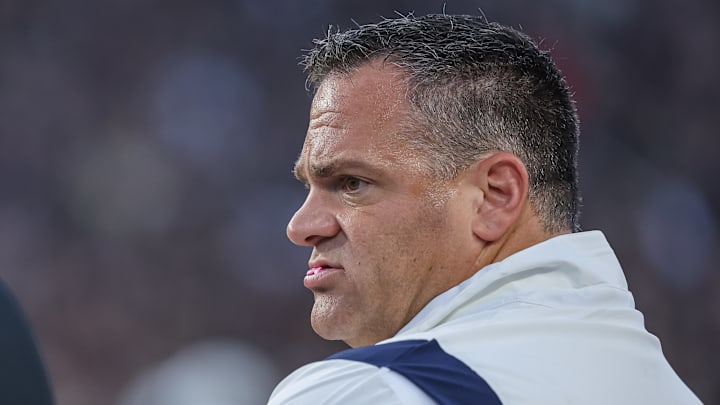
Less than a week after hiring Iowa State's Matt Campbell and bringing an end to a nearly two-month long process of replacing James Franklin, who was fired as the head coach of the football team just six games into his 12th season in State College, Penn State athletic director Pat Kraft announced that the university had initiated another head coaching search.
Lisa Bervinchak Love, who had been on staff for the field hockey team since 1994, was informed that her contract would not be renewed by the university, ending her three-year run as head coach. Just like that, Penn State had launched yet another national search for new leadership atop one of their athletic programs.
That search was brought to an end this past week with the hire of Hannah Prince, who had spent the past four years as head coach of the Saint Joseph's Hawks. Prince is set to become the seventh head coach in the history of the Penn State Nittany Lions Field Hockey team.
Hannah Prince named Penn State Field Hockey's new head coach!https://t.co/TdAr4EmTg8 pic.twitter.com/f1uw9nlW1p
— Penn State Field Hockey (@PennStateFH) January 13, 2026
The 33-year-old native of Gorham, Maine is only the second new coach hired by Penn State to lead the field hockey team since 1987.
Pat Kraft, Penn State send unmistakable message that can't be ignored
Kraft, who has served as Penn State's athletic director since being brought in from Boston College in 2022, has already made double-digit head coaching hires across the university.
Aside from Prince replacing Bervinchak Love, whom Kraft tabbed to replace Char Morett-Curtiss following her retirement in early 2023, and Campbell replacing Franklin, changes in leadership have been made in men's basketball, baseball, golf, soccer, and tennis, as well as women's golf and lacrosse, all within the past three years.
Sure, the Campbell hire stands out, not just because of its high-profile nature, but because of the circumstances surrounding it. Franklin was fired only six games after leading Penn State to the semifinals of the College Football Playoff. No other Penn State coaching change during that three-year stretch came about quite like that one.
As head coaching target after head coaching target signed new deals with their current schools, and Kraft's decision to fire Franklin mid-season quite literally generated nearly $400 million in extension money for the very coaches Penn State thought they could potentially scoop up to take his place, the pressure mounted on Kraft to get it right.
"If I don't get this right, my career is over," Kraft said back in December after the search finally concluded. "They will fire my a-- and I don't get another AD job. ... 'How could you f--- up Penn State?'"
It took nearly two months, far longer than anybody would have anticipated, but Penn State still came away with a huge hire.
Pat Kraft's vision: Good is no longer 'good enough'
Campbell may not have been their first choice; in fact, looking at the laundry list of coaches – Indiana's Curt Cignetti, Nebraska's Matt Rhule, Texas A&M's Mike Elko, Georgia Tech's Brent Key, Vanderbilt's Clark Lea, Missouri's Eli Drinkwitz, BYU's Kalani Sitake, Louisville's Jeff Brohm – whose institutions were forced to re-up to keep them in place, plus others such as Alabama's Kalen DeBoer, whose names continued to resurface throughout the search, he might not have even been in the top 10.
But he certainly would have been considered a top candidate for any other big-time head coaching job. Quite frankly, he had been considered a hot commodity in that market for years, even at the professional level, but had simply opted to remain in Ames with the Cyclones.
Looking back at the recent field hockey head coaching search, this was the closest thing to the football hire out of any major coaching change Kraft has made.
No, Bervinchak Love's departure wasn't labeled a firing like Franklin's; her contract was simply not renewed – and it happened six weeks after the season had ended, not in the middle of it.
But it still stands apart from most of the other recent coaching changes Kraft has had to make since arriving at Penn State. Those changes came about as a result of natural transitions that are to be expected within any collegiate athletic program, including retirements, resignations, and/or acceptances of other positions elsewhere.
None of them felt like a direct response to unmet expectations.
The 2023 field hockey team, fresh off their first Big Ten championship since 2013 and a run to the NCAA tournament semifinals the previous season, was ranked No. 5 in the preseason Penn Monto/NFHCA Division I National Coaches Poll. With their top two scorers returning, the Nittany Lions even garnered a first-place vote.
Three full seasons – and 32 polls – later, they have yet to be ranked inside the top 10 again.
The 2023 team went 9-7, including 4-4 in Big Ten play, before dropping their Big Ten tournament opener to an Ohio State team they had beaten during the regular season.
First, the elephant in the room: yes, they did actually beat Ohio State that year, which has become somewhat of a foreign concept on the gridiron.
But more importantly, we already know what the reaction would have been like from the broader Penn State community had the football team been ranked inside the top five in the preseason, with a No. 1 vote to boot, and underachieved.
Because we all just witnessed it.
We all saw that exact scenario unfold over the course of back-to-back-to-back weeks this past fall, and we all saw the further domino effect that those consistent shortcomings created.
Entering the 2024 field hockey season, Penn State had never failed to qualify for the Big Ten tournament since the tournament's 1994 inception. But with an 8-9 overall record and a 2-6 record in conference play, that changed. They were eighth of nine teams in the standings, and for the first time in 31 tries, they did not get in.
Then in 2025, they dropped to 7-10, missing the postseason with a 2-6 Big Ten record which once again placed them second-to-last in the conference. They ended the year having lost nine consecutive games in which they allowed at least one goal, and dating back to 2024, they have now dropped eight straight Big Ten games when allowing at least one goal.
Their run of three consecutive seasons falling short of the NCAA tournament is the longest in school history; they had only missed it in two straight years once before. Their run of three straight seasons without a postseason victory is also their longest, and prior to 2024, they had not even gone back-to-back seasons without a postseason victory since 2004 and 2005. Heading into 2026, the entire roster has just nine total minutes of postseason experience.
Simply put, it was time for a change.
During the 2025 season alone, the team lost leads in the final 90 seconds of regulation on three separate occasions. Their 29-game regular season winning streak in Big Ten home games that they had led at any point, an impressive run that had dated back to October 2015, also came to a shocking end in a must-win contest late in the year.
The 2025 season marked the first since 2015 in which the Nittany Lions did not record a single comeback win. They have now lost 12 consecutive games in which they’ve trailed at any point, a streak that dates back to the 2024 season.
Considering just how deep and talented the roster is – the 2025 team had 15 point scorers, the most since 2018, and 11 goal scorers, the most since 2019, and nine of those players are set to return in 2026 – and how many "what if" moments and missed opportunities held them back from what very well could have been at least a 10-win season in 2025, it had become clear that running it back was not a viable option.
A new direction was needed, and Kraft deserves a ton of credit for realizing that.
Penn State's standard is not just about football
He deserves credit for not treating field hockey like an afterthought and taking the easy way out by allocating all of the school's resources toward the football team, where much of the outside focus is placed – and where much of the public criticism or praise, justified or not, tends to be generated.
And he deserves credit for being willing to openly not accept good, but instead aim for great, even when it comes to a sport that might not otherwise draw a ton of attention from the average Penn State fan.
We've all heard the saying that you shouldn't try to fix what isn't broken. But in sports, especially at a school like Penn State, what's broken sometimes becomes subjective. And when that subjectivity is met, time and time again, with falling short of expectations, sticking with the status quo and accepting mediocrity becomes the easy way out.
Even if it isn't necessarily "broken".
At some point, good enough becomes no longer good enough, and when the standard for being good enough starts to become underachieved on a repetitive basis as well, change becomes necessary.
But as was the case with the decision to hire Campbell to lead the football team, the decision to hire Prince to lead the field hockey team was not one that came about overnight. This week's announcement culminated a nearly five-week coaching search. It was yet another hire Kraft knew he needed to get right.
Of course, there wasn't nonstop drama and a wild media frenzy surrounding it like there was after Franklin was dismissed, but nobody expected there to be.
It also didn't result in high-level candidate after high-level candidate signing massive extensions with their current schools. With those institutions eager to prevent those candidates from taking the Penn State football job, the theme of avoidance turned Penn State's search into a low-hanging fruit for online mockery as the twists and turns of those two months transpired. But again, nobody expected it to be that way on the field hockey side.
Yet it still resulted in the same message: Penn State is not willing to settle for anything less than greatness.
Penn State lands a proven winner in field hockey head coach search
If there were ever an iteration of Indiana head coach Curt Cignetti's now-famous "I win; Google me." line in terms of college field hockey head coaching hires, this would be the one.
𝐌𝐞𝐬𝐬𝐚𝐠𝐞 𝐟𝐫𝐨𝐦 𝐭𝐡𝐞 𝐭𝐨𝐩 pic.twitter.com/tPgmw3RXPE
— Penn State Field Hockey (@PennStateFH) January 14, 2026
Kraft didn't just check off a box; he swung for a winner.
Prince is a coach who built a national contender at a school that had not had a ton of field hockey success prior to her arrival as an assistant in 2017, and when she returned as head coach in 2022, she accelerated that growth.
Her coaching career began at New Hampshire, after she graduated from Massachusetts as a four-year starter and three-time Atlantic 10 conference champion in 2014. The Wildcats made two America East title game appearances in two years before she left for her first stint at Saint Joseph's in 2017.
Her first two seasons as an assistant coach at Saint Joseph's saw the team earn their first two NCAA tournament berths in school history, both times as both Atlantic 10 regular season and conference tournament champions.
A year later, she transitioned to Princeton as an assistant coach, and the Tigers made their first national championship game appearance since 2012. The following season at Louisville, she served as associate head coach and guided the Cardinals to their first ever national semifinal appearance.
She returned to Saint Joseph's in 2022, leading the team to a 16-5 record, both the Atlantic 10 regular season and conference tournament championship, and their first NCAA tournament win in school history. The team won both Atlantic 10 titles again in 2023 en route to another 16-5 record and NCAA tournament berth.
In 2024, the Hawks won another Atlantic 10 tournament championship, and they advanced all the way to the national championship game.
For a school that had never had a single team compete in any national championship game, that run was more than a big deal. It included an upset victory in the semifinals over North Carolina. At that point, the Tar Heels were the No. 1 team in the country, the two-time reigning national champions, and the winners of five of the six most recent NCAA tournaments.
She wins.
𝐒𝐞𝐭𝐭𝐢𝐧𝐠 𝐭𝐡𝐞 𝐓𝐨𝐧𝐞. pic.twitter.com/VpzjnI97s7
— Penn State Field Hockey (@PennStateFH) January 15, 2026
Now only a year and change removed from that unlikeliest of tournament runs, and following yet another Atlantic 10 tournament championship and NCAA tournament victory in 2025, she finds herself at Penn State, replacing a coach whose tenure with the university began when Prince was only two years old.
The change speaks not only to the message Kraft is sending, but to the fact that, even amid the team's recent struggles, the Nittany Lions team is a high-upside group well worth the gamble – both from Penn State’s perspective, and from Prince’s.
While one might not expect field hockey to be held to the same standard as a major revenue sport such as football or basketball, Kraft is out to prove that he is fully invested in the success of the university as a whole.
And that's a massive win for Penn State.
Expectations will be high, and there's a case to be made that such expectations can create added pressure. That was obvious when Franklin was removed from his post, six games after leading the Nittany Lions on what was by far their most successful postseason run of the College Football Playoff era.
But pressure is a privilege, and Kraft is granting that privilege to a program, a head coach, and a group of young, talented student-athletes who have earned it.
This latest move isn't just about fixing what's broken. It's about making sure that the days of "good" being the baseline are over. No matter the sport, excellence is the expectation at Penn State, and nothing less than that will suffice. Kraft had another tough decision to make, and just as he did with the football team, he made it with conviction, a conviction that reinforces greatness, not just good enough, as the Nittany Lion standard.
 Add us as a preferred source on Google