

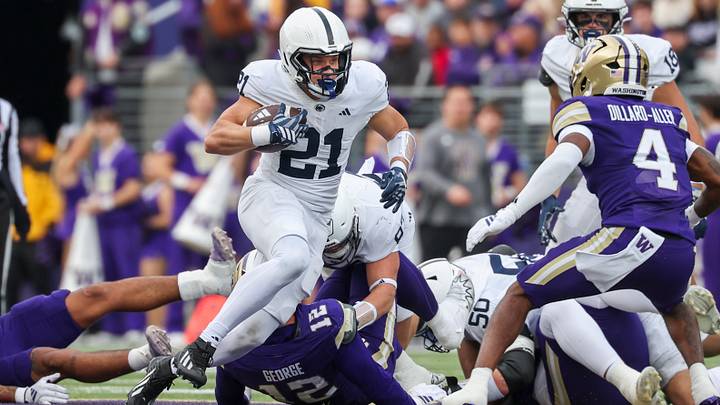
Through the first seven weeks of the season, Penn State had one of the worst run games in the country, and at least in the eyes of much of the fanbase, the blame lay with Iowa State transfer running back Carson Hansen.
Even as he averaged fewer than four yards per carry in Big Ten play, Hansen continued to handle the lion’s share of the opportunities in the backfield. There were persistent calls for Quinton Martin Jr., and rampant accusations of favoritism toward former Cyclones.
Campbell disproved the favoritism theory by starting Cam Wallace out of the bye week and, generally, by running a meritocratic program that has seen numerous Iowa State transfers on both sides of the ball lose snaps amid struggles.
Everything Campbell has said and done since he took over in Happy Valley would lead you to believe that if he had a better running back than Hansen, he would play him. And everything Hansen has done since Campbell and offensive coordinator Taylor Mouser revamped the run game in the bye week would lead you to believe that they don’t have a better running back than Hansen.
Penn State’s overhauled run game was tailor-made for its best running backs
During the bye week, I detailed the reasons that Penn State needed to scrap the zone run game and instead lean heavily on gap-scheme runs, particularly duo. However, most of my reasoning was about the fit for the offensive line, mitigating Malachi Goodman’s weaknesses, and playing to Trevor Buhr’s strengths to help the struggling left side.
If you listen to the coaching staff, though, they feel the changes were about having a run game better suited to the strengths of their running backs. Now, that obviously doesn’t include James Peoples, an impatient, zone-style one-cut runner who was the team’s primary third-down back early in the year. Peoples hasn’t played a snap since the bye week as Wallace and Hansen have split time in the backfield.



It is clear, though, that the gap-scheme runs have been a better fit for Wallace and Hansen, who rushed for 96 yards and a touchdown on 17 carries against Purdue. They followed that up with 119 yards and another score on 14 totes.
The offensive line is playing the best it has all season, even pushing around a Washington defense that came in ranked in the top 25 by rushing success rate. That’s undeniably helped Hansen’s efficiency, but whether it’s because he’s healthier after beginning the year banged up, because it’s been a major coaching point for the gap-scheme runs, or because he’s more comfortable with a less diverse menu of runs in the playbook, he’s running as well as he has in his career.
Carson Hansen’s newfound patience has him playing like a star
The key has been his patience, something that was not on display at all at the beginning of the year. That’s also been one of the differences between Wallace and the other two backs, Peoples and Martin, who haven’t seen the field much.
For all the calls for Quinton Martin and Cam Wallace's breakout performance against Purdue, Matt Campbell has been vindicated for sticking with Carson Hansen.
— Josh Yourish (@JYourish3) November 11, 2026
Hansen had an excellent display of patience against Washington. pic.twitter.com/8tVDRtB7KU
Simply, on inside zone or outside zone runs, the running back reads the defensive line and blocking flow to find the crease. On a duo run, however, the key for the running back is to press the double teams and read the linebackers. If the linebackers commit downhill to fill a gap, get caught up on a double team, or flow over the top, the running back takes the gap they vacate. That takes patience, and Hansen, on multiple occasions against Washington, had it in droves. His touchdown run is the best example (as detailed in the video above).
Unsurprisingly, Campbell and his staff knew Hansen’s strengths, knew how to build a run game tailored to them, and while it took too long, they’re finally getting the most out of him. That’s good news for a player who still has an additional year of eligibility remaining and, right now, is playing well enough to have a major role carved out for the Nittany Lions in 2027 if he returns.
Even two weeks ago, that statement would have been absurd. Now, I’d feel fine with Hansen as the lead back in a committee for next season. If this resurgence were just coming against lesser opponents late in the season, I'd read less into it. However, because the scheme has shifted so profoundly and the success has been the immediate result, it feels safe to say it's replicable.
 Add us as a preferred source on Google