

There have been plenty of different versions of successful Penn State offenses over the years, but even in 1994, when Kerry Collins was throwing it all over the yard, or in 2016, when Chris Godwin and Mike Gesicki were seemingly coming down with every 50/50 ball Trace McSorley could throw up, the identity started with the run game. Those two offenses in particular featured two of the best running backs in program history: Ki-Jana Carter and Saquan Barkley.
This Penn State team in 2026 doesn’t have one of those explosive offenses, doesn’t feature an elite running back, and most frustratingly, up through the bye week, hasn’t been able to run the ball.
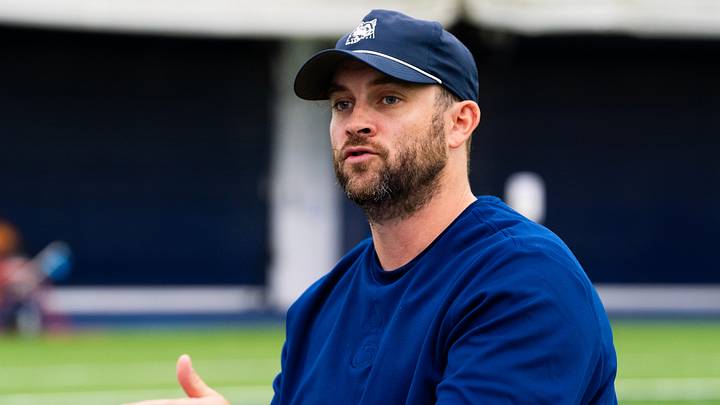
Clearly, with the week off before facing Purdue, finding success on the ground was a priority. As offensive coordinator Taylor Mouser explained on Tuesday, it was about getting back to basics. That’s not just in regard to schematic changes, ditching much of the zone-blocking scheme in favor of a physical, downhill, gap-scheme approach. It was about a mentality, and that started on the practice field.
“I went up to Coach Campbell and said, 'We’re going to spend the whole ‘indy’ (individual) time with this front seven, and we’re just going to block double teams for 20 straight minutes.' We don’t need to do pass-pro, I don’t need to throw the tight ends balls, we’re going to go and we’re going to hammer these double teams against these different looks, as many different ways as we can for 20 straight minutes, and we’ve done it every day through the bye week until today,” Mouser said.
The result, granted against a putrid Purdue run defense, was 269 rushing yards and 3 touchdowns, averaging 5.3 yards per carry, and 43 minutes of possession time. Or, in other words, a return to Penn State football.
Taylor Mouser is one of the biggest reasons to believe in Matt Campbell’s staff
There are 100 different reasons why it was important for Mouser to find a way to establish the ground game for the second half of the season, most of them grounded in the principles of successful offensive football rather than the tradition of the Blue and White. Still, it’s one thing to watch a struggling Penn State offense; it’s especially painful to watch a Penn State offense that can’t run the ball.
Mouser, probably more informed by his personal pride than that of the 100,000 or so who pile into Beaver Stadium week after week, seems to share that frustration. And, maybe most encouragingly, rather than trying to find an answer on the chalkboard, adding new, unique wrinkles to his run game, he simplified the identity, tailored it to what his line does well, and went to work on the practice field.
As simple as it sounds, that’s exactly what this team needed. A lot of coaching staffs would’ve outsmarted themselves; Mouser dumbed it down. And while optimism should be tempered after a win over Purdue, you have to feel good about the man in charge of Penn State’s offense.
Much like how running back Cam Wallace, who set a career-high in Week 9 with 135 yards on 22 carries, bubbled up through the depth chart by impressing in practice, Penn State found an identity through fundamentals. That’s coaching. That’s why Campbell and his staff came to Happy Valley with a reputation as great developers at Iowa State.
The only worry is that Campbell, Mouser, and this entire regime will convince themselves they can solve all of their problems this way if they start stringing together wins against a soft back half of the struggle.
But Penn State can’t trick itself into believing a developmental culture can carry it all the way to the top of the Big Ten
Coaching matters. A staff that understands how to maximize its team’s strengths is important. But in the transactional nature of modern college football, it’s not enough to offset the current talent delta that exists between Penn State and the programs it considers its primary competitors in the Big Ten.
If you pair this developmental, program-building mindset with a genuine willingness to churn the roster and replenish the program with higher-level talent this offseason, then this might work. If not, it’ll be a program that overperforms its talent but underperforms relative to the fan base's expectations and languishes in mediocrity.
There were certainly some Iowa State fans who got tired of it, but that will fly in Ames. In Happy Valley, there’s a remarkably short shelf life for the optimism that can be generated by passionate soundbites about run-blocking fundamentals after dominant outings against Purdue.
 Add us as a preferred source on Google