

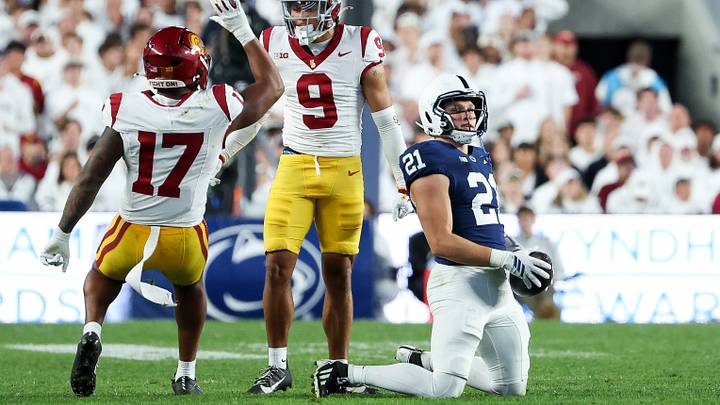
Largely, Penn State looked like a different team in its three non-conference wins to start the season. Wide receiver Koby Howard brought an element of dynamism to the passing game that has been absent since his injury, and quarterback Rocco Becht was surgical.
Since entering Big Ten play, that has all flipped, and the defense has largely fallen off a cliff, but the one throughline this season has been the struggles of the run game. Penn State couldn’t run the ball against Marshall, Temple, and Buffalo, and Penn State couldn’t run the ball against Wisconsin, Northwestern, USC, and Michigan.
But maybe, just maybe, coming off its bye in Week 8, Penn State will be able to run the ball in Week 9 when Purdue comes to town. Offensive coordinator Taylor Mouser has been desperate to establish an identity on the ground, admitting that his preferred one would be based on inside zone and duo runs.
However, as those efforts have largely failed, he’s tried everything and just about everyone, giving carries to Carsen Hansen, James Peoples, and Quinton Martin Jr., and finding limited success for all three in a variety of schemes. Coming out of the bye, Mouser has to decide what will be his staple on the ground and who will be his workhorse. And if it doesn’t work against Purdue, abandon all hope.
Purdue’s defense has been helpless all season
The Washington run game has somehow been about as bad as Penn State’s, ranking No. 118 in success rate and No. 80 in EPA/rush compared to No. 105 and No. 112 for the Nittany Lions, respectively. Yet, in Week 7 against Purdue, the Huskies put up 186 yards and two touchdowns on the ground, generating 0.10 EPA/rush.
The Boilermakers are worse at defending the pass, but rank No. 92 in the FBS in defensive rushing success rate and No. 122 in EPA/rush, allowing an explosive rush on 9% of opponents' carries. By those metrics, only Rutgers is worse in the Big Ten, and the Nittany Lions don’t face the Scarlet Knights until Week 12 of 13.
If this run game is going to turn it around, it has to be now. Otherwise, it’ll be too late for it to matter.
It’s time for Penn State to go all-in on a gap-scheme run game
Penn State's run game lacks an identity, and facing Purdue (No. 122 in EPA/rush) might be the last best chance to establish one.
— Josh Yourish (@JYourish3) October 26, 2026
Here's why I think that identity should start with duo, and why Taylor Mouser should go all-in on a gap-scheme run game: pic.twitter.com/6GiGc0pfyV
There are a myriad of issues with the Penn State run game. But the one that it seems has been toughest for Mouser to square this year is how incongruent his offensive line is, with four new starters on it.
The right side, behind Cooper Cousins and Anthony Donkoh, is suited to a physical, mauling, downhill run game. However, the left side, with Trevor Buhr at left guard in particular, is best out in space as pullers. Left tackle Malachi Goodman hasn’t been particularly good at much as a run blocker, with his high pad level ceding leverage immediately.
Buhr has his best game as a run-blocker against Michigan, primarily because of how much pulling Mouser asked him to do. Cousins, when asked to pull, however, lunges at the target and more often than not, comes up empty. The lack of patience from running backs doesn’t help the cause, but before dealing with that issue, Penn State needs to get its offensive line comfortable with something.
More than just running power, counter, or pin-pulls, which were very effective for Washington against a slow-footed Purdue second level, duo should become Penn State’s bread and butter. It leans into the strengths of the right side, and when Goodman is on the backside, it mitigates his impact on the success of the play, simply walling off the backside edge.
Inside zone isn’t working. Outside zone has been just as bad. While those have been staples for Mouser in the past, it’s time to embrace the gap scheme and hope your running backs can adjust.
 Add us as a preferred source on Google