

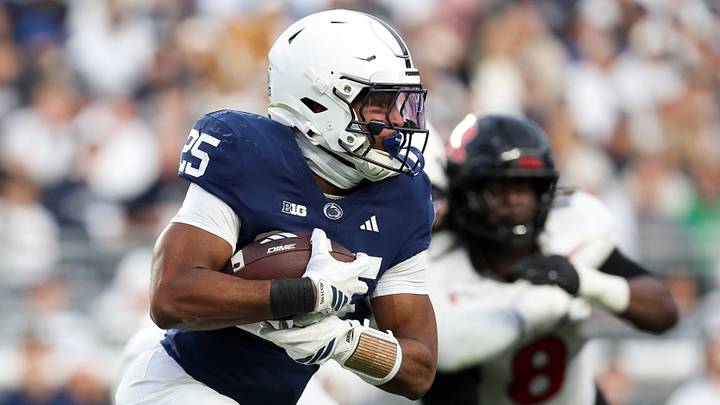
It was just about unthinkable that, as a 24.5-point pregame favorite with a two-touchdown lead in the fourth quarter, Penn State would find a way to lose to Rutgers for the first time since 1988. Even before the game, it was hard to imagine a world where a Rutgers team that lost to UMass in Week 1 and was coming off a 31-0 loss to Nebraska would even be competitive inside Beaver Stadium, no matter how banged up Penn State was.
Beyond that, you could never have conjured up the uniquely gut-wrenching manner in which Penn State lost, with a questionable pass interference call on a fourth-and-10 with 10 seconds left giving the Scarlet Knights another chance. Then Antwan Raymond’s lateral to Ben Black III for a touchdown as time expired before walking it off with a two-point conversion from AJ Surace to Clay Thevenin.
Needless to say, it was a bad day at Beaver Stadium. But these five “losers” had the worst days.
Losers:
5. Jeremiah Cooper
Jamison Patton was on the injury report and played just eight snaps. Zion Tracy, Penn State’s other starter at safety, “tweaked himself” in warmups, according to Matt Campbell’s postgame press conference, and he didn’t play a snap after being announced as a starter. That left Cooper to play 71 of the 75 defensive snaps, and he made just two tackles and was charted with as many missed tackles by PFF.
Cooper also allowed Raymond to get the edge on his first touchdown of the day and was unable to bring Raymond down on his second rushing score. He’s not the only one with a tackling issue on the back end of Penn State’s defense, but his issues have been glaring.
4. D’Anton Lynn’s late-down defense
Penn State’s defense is not built to protect a lead. The defensive line just doesn’t have the pass-rushing juice to put a team away when it has to drop back to chip away at a deficit. That led to a run of third-down conversions by a banged-up Surace and a Rutgers offense without KJ Duff.
When the defense didn’t bring heat, Surace sat in comfortable pockets and found receivers open downfield for conversions. When Lynn did dial up the pressure, particularly by blitzing Tony Rojas, who is also the Nittany Lions' best open-field tackler, his defense got burned on the ground without defenders in the second level to bring down Raymond.
In all, Penn State allowed Rutgers to convert on four of its last nine third downs after starting 0-for-8, and converted on three of its four fourth-down attempts. Surace and the offense converted on fourth-and-6 and fourth-and-10 on their 19-play touchdown drive to pull within one score, and got a fresh set of downs on fourth-down via pass interference to set up the game-winning score.
There is some random fourth-down variance at play here for sure. Penn State went 0-for-2 needing a yard both times, and Rutgers went 3-for-4 with much longer attempts. That’s probably not repeatable, and “opportunity conversion rate” cost Penn State 16.7% win probability. Those plays are significant, and it’s a small sample, so sometimes it won’t break your way. But protecting leads has been an issue for this defense all year, so you can’t just chalk it up.



3. The running back room (but mostly Quinton Martin Jr.)
Lynn’s transgressions wouldn’t have been so impactful if Penn State could have simply possessed the ball in the second half of the game, but in the fourth quarter, the Nittany Lions ran just eight plays, gained 26 yards, and salted away only 4:43 of the game clock.
That’s unacceptably bad for an offense that has found new life on the ground since the bye week. Coming into the game without Carson Hansen, the offense was already short-handed; then, after losing James Peoples in the first quarter, it was down to Cam Wallace and Quinton Martin Jr.
Wallace hit a big play, taking a nicely designed pitch 56 yards to the house. However, he was also stuffed in short yardage, managed just a 38% success rate, and had a bad fumble on an exchange with Becht. At least he did hit the big play, though, and finished with 96 yards on 16 carries.
Martin, whom fans were clamoring for early in the season when the run game was struggling, showed exactly why he could never crack the backfield rotation. Seeing his first carries since Week 7, Martin went for 12 yards on seven carries (1.7), with a long of three, and didn’t record a single successful play. He’s clearly the team’s fourth-best running back, and frankly, probably not a Big Ten caliber player. He lacks the vision and patience necessary to allow his quickness and speed to be valuable.
2. Matt Campbell
Campbell isn’t getting massive props for beating Rutgers. No, that’s an expectation in Happy Valley. In fact, beating Rutgers by such a slim margin warrants distinction as a loser for the head coach.
There was a positive sequence in the second half when Rutgers head coach Greg Schiano, after having a 57-yard field goal wiped off the board due to a false start, sent out his punt team, facing fourth-and-8, and then quickly ran his offense onto the field. Rather than panic and call a timeout, as he did in a similar spot against USC and Lincoln Riley earlier this season, Campbell stayed cool, subbed his defense on, and forced a delay of game.
Later, however, he spent his timeouts in less-than-ideal times, and pretty comprehensively coached not to lose against a Rutgers team that lost to UMass at the beginning of the year. So, maybe any game-management growth is overstated. Then there were all the penalties.
1. Big Ten refs
The fourth-down pass interference on Daryus Dixson (it was called on Audavion Collins but appears to be attributed to Dixson on the play) was completely bogus. As was the unsportsmanlike conduct on Josiah Zayas that extended a drive much earlier. Time and time again, in big spots, penalties gave Rutgers life.
That’s not even to say it was purely one-sided. Rutgers had a big third-down conversion wiped out by a blindside block flag that was hard to justify. The referees, as is far too often the case in college football and the Big Ten in particular, played an outsized role in the outcome of the game.
 Add us as a preferred source on Google