

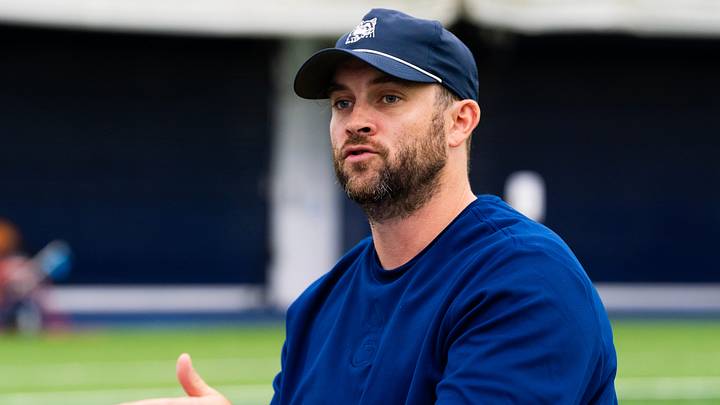
Coaching staffs are going to make mistakes. When they do, fans want them to take accountability. They’d prefer they don’t make as many mistakes as Penn State’s staff did in its 24-20 Week 4 loss to Wisconsin on Saturday, but offensive coordinator Taylor Mouser appears to have the accountability part down.
Mouser has faced plenty of criticism for his play-calling against the Badgers, particularly on third-and-down and in the red zone. Late in the game, as Penn State’s 17-0 lead was dwindling, Mouser continually called third-and-long run plays, and on Tuesday, in his media availability, he flatly admitted that it was “cowardly.”
“As cowardly as it feels from my standpoint to do that... it's like the flow of the game... didn't feel like we created a great rhythm in the passing to be able to go and execute... play the field position game, as dumb as that sounds and as much as I hate to say that."
If nothing else, Mouser’s honesty is refreshing, but just as he shouldered the blame for Penn State’s run-game struggles through the first two weeks of the season, which returned against the Badgers, it’s not just about accepting responsibility; it’s about finding solutions.
Taylor Mouser can fix Penn State’s third-down cowardice
In a lot of ways, Mouser and Campbell’s theory of how to approach third-and-down late in the game was probably right: the offensive line was struggling to pass-protect, Rocco Becht had already thrown one interception and nearly threw a few more, and nobody in blue and white was separating downfield. There was a big risk of giving the game away with a turnover, but the risk of shutting it down too early and getting run by was, apparently, just as big.
Still, for as “dumb” as Mouser and Campbell look now, if Wisconsin tight end Jacob Harris doesn’t truck Marcus Neal Jr. at the top of his route on his 72-yard game-winning touchdown, Penn State probably escapes at 4-0.
It’s hard for a play-caller to stay aggressive when nothing is clicking downfield, and your defense appears to have the game in hand. Mouser is still just in his third season calling plays, and he even admitted that Campbell had a hand in the late-game approach. Cranking up the aggressiveness is an easy fix; doing it successfully may not be.
Without Koby Howard, who is clearly Penn State’s best offensive player, the Nittany Lions didn’t have any element of explosiveness on offense. They also didn’t have any answers in the red zone, which was a problem when Howard was healthy, too.
The red zone offense is a different story
Penn State’s 50% red zone touchdown rate ranks No. 114 in the FBS after four weeks. Its 80% scoring rate is No. 98. It’s not just a small sample either, because Mouser’s offenses weren’t especially effective in the red zone at Iowa State.
Mouser stated it simply, “I have failed our offense from that standpoint."
But it might not just be on the play-caller. Becht is the other common denominator in those struggles, and while activating him in the run game helped against Wisconsin, it’s not a sustainable solution, especially with Becht coming off a 2025 season in which he finished with two shoulder injuries.
Becht is a quarterback who likes to push the ball downfield and often predetermines the matchup he wants to attack pre-snap. In the red zone, you lose the vertical threat, and if you don’t have elite wide receivers, it’s hard to win one-on-one in tight spaces. So, it’s largely up to the run game, which hasn’t been much better.
It’s good that Mouser understands that he needs to be better, and it seems like he’s intent on making meaningful change. But does he have the right pieces? That’s what’s tough to discern because he’s been an effective play-caller before.
 Add us as a preferred source on Google