

College Football is no longer the sport in which one regular-season loss ruins your year. The College Football Playoff has expanded to 12 teams and will almost certainly be expanding to 24 teams shortly. There is time to save your season if it’s off to a bad start, but that doesn’t mean you ever want to lose at home as a 10-point favorite when you get three interceptions, including a pick-six.
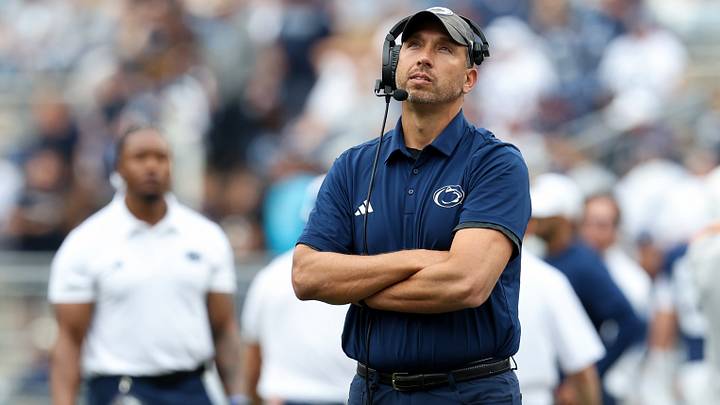
That’s precisely what Penn State did on Saturday, blowing a 17-point lead to Wisconsin in Matt Campbell’s Big Ten debut. It was a horrific loss, the direct result of Campbell’s overly conservative approach and a team built around Iowa State transfers that’s just not all that talented.
It’s not happy times in Happy Valley right now, but is the sky falling? Is it time to break out the panic button and declare that athletic director Pat Kraft was right to pass on Matt Campbell so many times in his coaching search before finally circling back? Or that he was wrong to fire James Franklin in the first place. Or worse, that the expectations around this program are unrealistic and that Penn State has to accept its fate as a middle-of-the-pack Big Ten program?
Not quite yet.
It was ugly. It was frustrating. But it’s not the end of the world. I’m here to set the panic levels for this program after Week 4.
Overall: 3/10
It’s Year 1 of the Matt Campbell tenure after a mass exodus of talented players from the program, both to the NFL and to follow James Franklin to Virginia Tech. Campbell isn’t a Lane Kiffin type who’s going to go buck wild in the Transfer Portal, and Penn State isn’t spending $40+ million on this roster, which is almost certainly what it’s going to take to win a title in the sport right now.
Resets are hard. Sure, coaches in college football hit the ground running now faster than ever before, but Campbell is a developmentally minded program builder who needs to get his operation up and running before he’s really expected to win big.
Was that the wrong type of coach to hire in this current environment? That could be worth a conversation down the road if he doesn’t progress beyond the realm of Wisconsin and the rest of the Big Ten middle class, but right now, this was one loss against a program that spent big this offseason to get better, and it came without Penn State’s best offensive player on the field.
This season’s College Football Playoff hopes: 9/10
That said, this year’s College Football Playoff hopes have gone by the wayside. Belief in Penn State as a playoff team was based on its schedule more than its roster, and even at 10-2 with losses to Michigan and USC, it was going to be hard to get into the field as an at-large. Now, 10-2 seems unlikely, and USC and Michigan also lost at home in Week 4, so even beating one of those teams may not hold up as a quality win.
Penn State does still have an easy schedule. It could still theoretically beat every team left on it, but doing so in succession after the performance they just put out in Week 4 would be truly shocking. The good news is that even if Penn State had made the CFP this year, it would’ve been pretty fraudulent and could have misled the program in ways that could potentially be detrimental to Campbell’s long-term success.
The 2026 offense: 10/10
As currently constructed, this is a bottom-half offense in the Big Ten, if not lower, and Rocco Becht might be a bottom-half quarterback in the conference, if not lower. Becht was wretchedly bad against the Badgers, and without Koby Howard, all the wide receiver worries that have plagued this program for years sprang back to life.
The offensive line hasn’t opened holes for the running backs, and James Peoples is the only one showing any real burst against a team that isn’t Buffalo. The philosophy of this offense to be a physical between-the-tackles run game with 12 and 13 personnel that forces defenses to put big bodies on the field so you can gash them through the air is a good one, but it falls apart if you can’t run the ball and if your big-play receiver, in this case Brett Eskildsen, hauls in none of his six targets.
It’s hard to say offensive coordinator Taylor Mouser is at fault because this unit just isn’t very talented by Big Ten standards. At least not without Howard. And if one player makes that significant a difference, it’s just not a good unit.
The 2026 defense: 4/10
D’Anton Lynn’s defense was surprisingly disruptive considering the lack of pass rush it got. Lynn can create problems with his coverage disguises, simulated pressure looks, and a really talented back seven. However, without any real pass rush, and this week Ikenna Ezeogu was good but didn’t get much help, Penn State is going to struggle to protect leads.
This is a good unit. It’s just not quite good enough to carry the team if the offense is actually as bad as it looked in Week 4.
As for the big play it gave up to lose the game, it was a result of tight end Jacob Harris bulldozing Marcus Neal Jr. at the top of his route, so it’s hard to put that on Lynn or this unit as a whole.
The success of Matt Campbell’s tenure in Happy Valley: 2/10
This isn’t a Year 0 situation; that would be disrespectful to the Penn State program and, frankly, everything James Franklin built to rescue it from an incredibly dark place. However, it is a hard reset, and Campbell was hired far too late into the process after Kraft whiffed on Kalani Sitake.
It’s a roster largely built around an Iowa State team that went 8-4 last year and a team that lost two incredibly impactful young players in Max Granville and Koby Howard to injury. This team wasn’t supposed to win a national championship, and while a CFP appearance would have been nice, it’s fair to have some patience with Campbell.
Campbell as a game-day coach, I’m more worried about after that meltdown. He coached like the game was over after his team went up 17, running the ball on third and long, conceding possessions, and not being aggressive with all three timeouts and over a minute left before halftime.
This isn’t a young, inexperienced head coach. He should have won that game. But not to necessarily compare the two, Mario Cristobal had a lot of games he should have won early in his tenure at Miami, and nobody is thinking about that now because he got so many of the big-picture things right.
Recruiting: 4/10
Campbell’s 2027 class ranks No. 20 in the country and lacks the elite in-state talent that could have vaulted it into the conversation as one of the best in the Big Ten. But Campbell seems to have improved his in-state connections for 2028, holding commitments from two of PA’s best recruits, including its best quarterback, James Armstrong.
Campbell will never be an elite recruiter. But he can probably be good enough to have this team competitive in the Big Ten. Some 2028 results soon would ease any mounting concern, but if he holds onto his 2027 group through signing day, then he’s in a good spot.
Overall, Penn State needs to increase its investment to be closer to Ohio State and Oregon. Honestly, that would probably make a bigger difference on the recruiting trail than any incremental growth Campbell has now that he’s recruiting at a higher level.
Development: 1/10
Matt Campbell and his staff are developers. That’s why Iowa State was so successful, and Penn State is already seeing the benefits of that with young, under-recruited players like Josiah Zayas and Amarion Jackson making an impact as true freshmen. Now, maybe that’s more a credit to their evaluation process than developmental chops, but either way, it’s positive.
 Add us as a preferred source on Google