

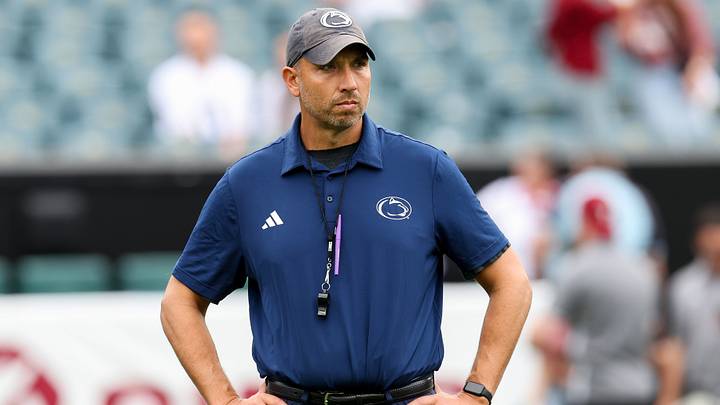
For 10 years, Matt Campbell punched above his weight class at Iowa State, leading the Cyclones to their most successful decade in program history. Now, as the NIL and revenue-sharing era matures into a place where roster spending can be meaningfully tracked, it’s become even clearer just how impressive that was.
This season, under Jimmy Rogers, Campbell’s replacement in Ames, Iowa State has the fourth-cheapest roster in the FBS, according to The Athletic’s comprehensive report, which gathered multiple budget estimates for each program and ranked them based on the average. Penn State, Campbell’s new home, ranked No. 22, clustered with Clemson, Oklahoma, Nebraska, and Wisconsin.
According to the report, Iowa State is spending between $13 and $17 million on its roster, while Penn State is spending around $30 million in 2026. And though Campbell’s budget may have doubled, so have his expectations, and relative to the rest of the Big Ten, he’s still being asked to do more with less.
Penn State is spending the 7th-most on its roster in the Big Ten
There’s no guarantee that Iowa State was definitely fielding the 4th-cheapest roster last season, but it was certainly near the bottom of the FBS for most of Campbell’s tenure. That’s one of the reasons he was such an intriguing candidate for a job in the Big Ten or the SEC, and why the NFL even came sniffing around at different stages of his tenure.
There’s also no guarantee that Penn State remains the 7th-most expensive roster in the Big Ten throughout his tenure. It seemed that the Nittany Lions were closer to the high-end roster in 2025 under James Franklin, bringing back a bevy of veteran talent from its 2024 College Football Playoff team while simultaneously making Jim Knowles the highest-paid coordinator in the sport, which wouldn’t be reflected in roster spending but matters in terms of resource allocation.
For athletic director Pat Kraft’s part, he needs to close the gap to Ohio State and Oregon, which are spending nearly $50 million, if not more, this season, if he wants his football program to compete for Big Ten titles. And until that happens, it’s a good thing that Campbell is comfortable as the underdog, spending much of his career developing underrecruited talent into impactful players, which is the best way to maximize roster value in this era.
Winning a national championship is no longer about stacking five-stars as it was during Nick Saban’s reign over college football in the 2010s. Instead, it’s increasingly about optimal resource allocation, which is why general managers are now commonplace and why it was critical that Derek Hoodjer accompanied Campbell from Ames.
Should Penn State be recalibrating its expectations?
It’s fair to expect Penn State’s spending to increase after Year 1 of the Campbell era. Franklin’s buyout didn’t prove to be arduous at all with his offset clause, and ultimately cost less than $10 million, so that wasn’t a major line item, but overhauling a staff isn’t cheap and isn’t reflected in roster spending. Neither are major renovations on Beaver Stadium. Plus, because so much of the roster was imported from Iowa State, most of the players could reasonably receive a significant raise while still representing surplus value compared to their Big Ten counterparts.
The theory behind hiring Campbell is essentially: what happens if you give the coach who does more with less more? And he does have more compared to Iowa State, but compared to the programs Penn State expects itself to compete with, there’s an even larger gulf.
Unless Kraft can get Penn State to a place where it is closer in roster spend to Ohio State than it is to Iowa State, then it will be time to ask a pretty existential question about the program, because, pretty quickly, Wisconsin and Nebraska, the two Big Ten programs closest in 2026 roster spend, could start to become your peers instead of punching bags.
Ideally, Campbell can manage that delta between outside expectations and the reality of a middle-class program while administration starts to pump more money into the program. He’s done it before, but if you remove Texas Tech, which only became a Big 12 outlier in terms of spending last season behind mega-donor Cody Campbell, the difference between Iowa State at the bottom of the Big 12 and TCU at the top is, at most, $12 million. And that’s if you take Iowa State’s low-end estimate and TCU’s high-end at $25 million.
The difference between Penn State at No. 7 in the Big Ten and Ohio State at No. 1 is at least $17 million, if you take Penn State’s high end and Ohio State’s low end. At most, it’s $26 million. Campbell is now on the high-end of the Big Ten average compared to the low-end of the Big 12 average, so maybe he can press that advantage against everyone else in the conference, but compared to the top, he’s actually at a bigger disadvantage than he was in Ames.
Of course, I removed the Texas Tech outlier, and by percentages, from Iowa State to TCU is larger (92% compared to 89% when taking the largest possible range of estimates), but the percentage points don't really matter when every million dollars or so is a difference-making player.
 Add us as a preferred source on Google