

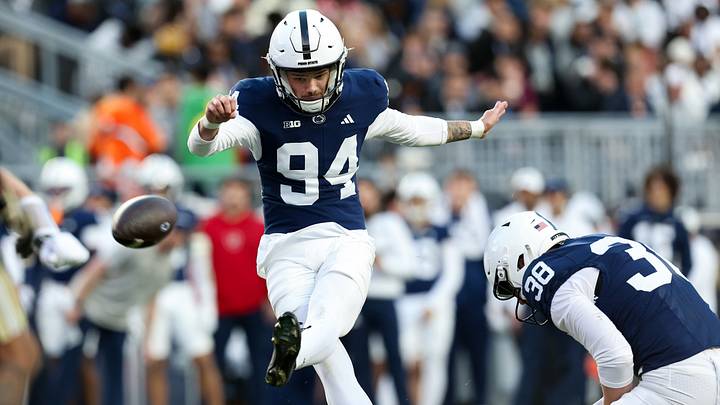
It’s not actually a third of the game; technically, only about 17-20% of plays in a college football season are special teams plays. But that’s still probably a bigger slice of the pie than we typically lend credence to when handicapping a game.
Offense and defense are more determinative, but particularly in a matchup between similarly power-rated teams, as is taking place in Seattle in Week 10 when Penn State visits Husky Stadium, special teams margins can swing the game.
At first glance, it would seem that the special teams edge goes to Penn State, but when you dig a bit deeper and remember Ryan Barker’s two missed kicks in Week 9, that may not quite be the case.
Penn State has a major field position edge over Washington
What I mean by “at first glance” is that Penn State has a clear-cut edge over Washington in terms of average starting field position. Now, that’s not purely a special teams thing, but the kicking and punting game play a pretty major role in it.
For the season, Penn State has a net starting field position edge over its opponents of +5.8, which is No. 11 in the FBS, while Washington is at a -3.7-yard deficit, ranking No. 113.
That simply gives Penn State more chances to score, which is critical for an offense that has struggled so comprehensively in the red zone for much of this season. And that lack of red zone success is a major reason why, despite an average starting field position of its own 26-yard line and a 43% offensive success rate, which ranks No. 78, Washington still manages to outpace Penn State with 4.33 points per opportunity to 4.08 points per opportunity.
Pressing that field-position edge will be vital. Fourth-down decision-making, something Washington head coach Jedd Fisch has been incredibly conservative about this year, will factor in determining field position in what is expected to be a low-scoring game. When do Fisch or Campbell take a fourth-down risk, and does it set up their opponent with great field position and a chance to swing the game?
Campbell, compared to Fisch, has been more aggressive on fourth down, with a 23.8% go-rate, ranked No. 87 nationally compared to Fisch at No. 106, and a higher rate of agreement with the analytical models when they suggest going for it on fourth down. Neither coach is exactly a riverboat gambler, but Campbell’s willingness to trust his offense could work to mitigate the special teams advantages Washington surprisingly has.
Washington’s nightmarish kickoff numbers could sink the Huskies
Special teams | Penn State | Washington |
|---|---|---|
Special teams expected points/game | 1.39 (60th) | 0.57 (87th) |
EPA saved/kickoff | 0.13 (33rd) | 0.05 (85th) |
EPA/kick return | 0.08 (38th) | -0.03 (107th) |
Punting points gained/punt | -0.10 (112th) | 0.14 (49th) |
EPA/punt return | 0.08 (44th) | -0.15 (120th) |
Field goal points gained | 0.8 (74th) | 3.9 (44th) |
Washington’s low expected points/kickoff is part of the reason its field position differential tends to be such an issue. Otherwise, the Huskies have the edge over Penn State’s punting and field goal units. It’s just been such a disastrous season kicking off, kicking off that the Huskies grade out unfavorably as a special teams unit overall.
Washington leads the country in kicks out of bounds with five, tied with Western Michigan, contributing to an average opponent starting field position at the 25.9-yard line off a Washington kickoff. By fourthandshort’s “placement” metric for kickoffs, Washington ranks No. 135 of 138 FBS teams.
Now, in a low-scoring game, that impact could be mitigated, and an accurate field-goal kicker, as the Huskies have in Tyler Robles, could have more of a say in the outcome. But also, in a low-scoring game, field position is critical, and if the season-long trends continue, Penn State should have a considerable edge in that department.
 Add us as a preferred source on Google