

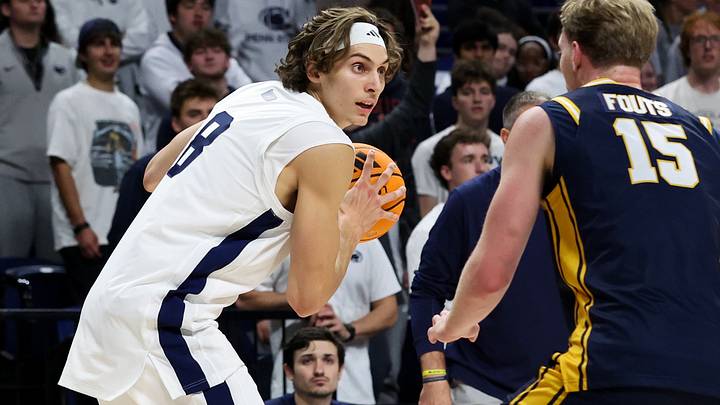
Depending on how closely you follow European recruiting in college basketball, which is a whole new avenue for talent acquisition with a much less robust public rankings apparatus, you probably have some understanding of how important Roko Prkacin could be to Penn State in 2026-27.
The 23-year-old power forward, originally from Croatia, was a multi-year pro in the top French league and was considered by some to be a top international transfer in the entire sport this year. It’s not often that type of talent winds up in Happy Valley, especially not with the program’s relative lack of investment.
But somehow, Prkacin did; he won his eligibility case with the NCAA on Saturday, two days before the Nittany Lions’ season opener on Monday night against Canisius at the Bryce Jordan Center, and in his debut, he was immediately the best player on the floor.
Playing just 20 minutes off the bench, Prkacin led all scorers with 28 points on 12/14 shooting and 4/5 from the free-throw line in Penn State’s 97-57 win. The athletic forward was a monster from two-point range and dominated in transition, using his long strides to routinely beat everyone down the floor and his impressive vertical pop to finish with an exclamation mark.
He’s clearly the best player on head coach Mike Rhoades’ roster in his fourth year at the helm, and maybe he could be the type of talent to elevate the preseason No. 18 team in the 18-team Big Ten out of the basement.
Roko Prkacin unlocks a ceiling it wasn’t clear that Penn State had
Largely, a roster built with late-career veteran transfers, shying away from a young team led by Kayden Mingo last season, was assembled to raise the floor for a program that won just 12 games last year. It appears that Mingo is about to embark on a breakout year at Baylor, but it’s still likely a smart pivot from Rhoades, who had long built teams with a hard-nosed defensive identity.
This team is absolutely that. With length all over the place, Penn State can routinely play lineups with four players 6-foot-7 or taller, most of whom are at least 21 years old. That was the case for Penn State’s starting lineup, which featured 6-foot-2 Dasonte Bowen at the point, 6-foot-7 Thomas Allard, 6-foot-8 Brant Byers, and 6-foot-8 Josh Reed on the wing, and 7-foot Ivan Juric at center.
While that unit doesn’t have any regular 15-to-20-point scorers and instead features mostly spot-up three-point shooters around Bowen and Juric, it won’t be easy for even Big Ten opponents to operate offensively against it. If that were the model of this entire team, including Prkacin, that would probably raise the floor to the point that Penn State doesn’t finish dead last in the Big Ten.
However, Prkacin seemingly has unique offensive upside that could, if everything hits right and he continues to play close to the same level in the Big Ten, elevate this team closer to the middle of the pack. And with an expanded 76-team NCAA Tournament, it’s not unthinkable that Penn State could find itself on the bubble. It’s still unlikely, but we have to see just how good Pkracin is.
Mingo was supposed to be a player who brought Penn State basketball this type of hope, but he was a true freshman saddled with massive creation responsibilities on a team largely devoid of supporting talent. Prkacin is a 6-foot-8, 23-year-old with pro experience, and he has more help around him. Reed should probably slow down on the LeBron comparisons, but it illustrates the point that he’s a big, physical offensive creator, presumably more able to withstand the rigors of a Big Ten schedule.
Most of Prkacin’s production came as a cutter, offensive rebounder, and in transition. Not that those aren’t skills, but he’ll probably need to show more as an on-ball shot-creator to truly be the offensive focal point for this team. If he does, and there were flashes of it against Canisius, this could be a much more intriguing season than expected.
It was obviously important that Prkacin got eligible, but it wasn’t entirely clear he’d immediately be this team’s best player. So good thing that NCAA ruled in his favor.
 Add us as a preferred source on Google