

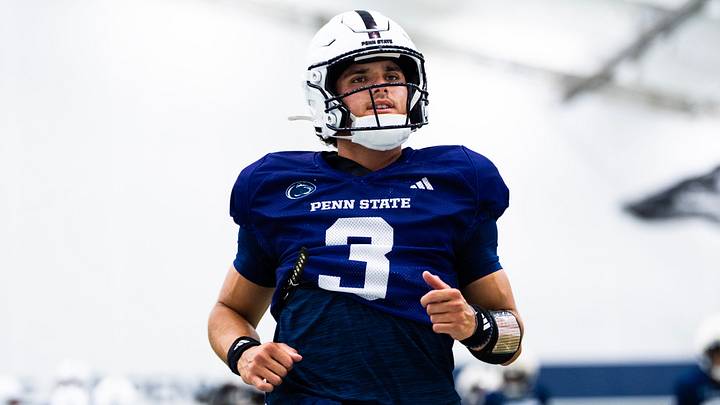
There are levels to the quarterback position, and one of the best delineators is a simple question: Is said quarterback a guy his team can win with or a guy his team wins because of?
It’s subjective, of course, but with 39 career starts under his belt, it’s safe to say Rocco Becht is a ‘win with’ quarterback. That’s not a slight, necessarily. Plenty of ‘win with’ quarterbacks have won national championships in the past: Will Howard in 2024, Stetson Bennett, at least in 2021, Jake Coker in 2015, Cardale Jones in 2014, and the list goes on. His NFL career may even thrust J.J. McCarthy into that territory. There are even some ‘win despite’ QBs who have come close.
If you have a ‘win-with’ quarterback, it just means that the roster around him has a higher bar to clear. The complementary football every coach strives to play has to be that much more complementary. The problem is that it became more difficult as the NIL/Transfer Portal era brought an end to teams hoarding blue-chip talent and thinned the margins at the top of the sport.
Even so, if Penn State hopes to get back to the top of the sport in Year 1 of the Matt Campbell era with Becht in his final season of eligibility, it’s more reasonable to expect the rest of the roster to close that gap rather than Becht crossing that arbitrary line into becoming a ‘win because of’ QB in Year 4 as Campbell’s starter.
Rocco Becht may have a hard ceiling on his development
Now, I’m not completely discounting the idea of Becht becoming a meaningfully improved player at 22, almost 23 years old in his fifth college season. If that level of growth is going to come, it typically happens earlier, but on rare occasions, as players age, the physical and mental advantages they eventually build up over their, in most cases, younger competition can tip the scales.
Kenny Pickett is probably the best example of this - a multi-year starter who had a major breakout in Year 5 as a fourth-year starter. However, considering that, unlike Pickett, who spent his entire career in the ACC, Becht is making the jump from the Big 12 to the Big Ten, I’d put the chances of that type of outlier season at fewer than 5%.
So, where will the improvements come on an offense that has Becht, who was No. 72 by EPA/dropback, and his top-five receivers from a unit that finished No. 62 in points per drive last season? It could come from the receiving corps, though they, too, are leveling up to the Big Ten. Maybe it’s the running back room, though Carson Hansen failed to crack 1,000 yards on the ground last year and James Peoples is an Ohio State cast-off.
Potentially, it's a tight end group that was excellent in Ames and now has Andrew Rappleyea joining it. But my best guess isn’t a particular position group but a specific area of the field, and success there will rely on a revamped offensive line, that elite tight end group, and the viability of offensive coordinator Taylor Mouser’s stubborn bullyball approach.
Red zone efficiency is Penn State’s path to offensive improvement
Becht is a solid runner, but not a true plus athlete. He’s got a good arm but not great, so he has to throw with aggressive anticipation, which can be great but also get him into trouble. And he’s a good processor from the pocket, but far from a terminator-level precision passer. He’d rather pick his matchups and give his receivers a chance, much like Trace McSorley did back in the day, though it’s not a one-to-one comparison.
Those are the main reasons he’s a ‘win with’ player, and the limitations they create tend to show up most on late downs and in the red zone. When the field shrinks, it’s harder to play the matchup game, harder to create space for one-on-ones, and when you do get them, tougher for receivers to create lasting separation. So, what did Mouser do? He ran the ball.
Last season, Iowa State had a 78.1% run rate in the red zone. Penn State was actually higher at 79.7%, but the Cyclones, with a veteran, experienced QB you would presumably trust in those situations, toted the rock at the 17th-highest rate in the country. It didn’t necessarily pay off, though.
With that high run rate, Iowa State finished No. 82 in red-zone scoring percentage and No. 58 in red-zone touchdown percentage (per CFBstats.com). In case you’re wondering, Cyclone kickers missed just one field goal inside 40 yards. Increasing those numbers is Penn State’s best chance for meaningful offensive improvement over last year’s Iowa State offense, and assuming Mouser sticks to his high run rate, it hinges on a ground-and-pound approach becoming more effective with a move from the Big 12 to the Big Ten.
If that sounds like a troubling proposition, that’s because it is. Hanson is a capable back, Gabe Burkle is one of the best blocking tight ends in the sport, and with Burkle, Rappleyea, and Benjamin Brahmer, Penn State’s 13-personnel look will be as intimidating as any in the country. The offensive line only imported one Iowa State starter, left guard Trevor Buhr, instead leaning on returners Anthony Donkoh and Cooper Cousins as starters on the right side, Texas State transfer Brock Riker at center, and one of three returners with fewer than 50 career snaps at left tackle.
That group should be good. It should be better than what Campbell and Mouser had in Ames. But will it be good enough to road-grade in the red zone when the field shrinks, and Big Ten defenses can load the box? Against much of Penn State’s soft schedule, probably. Maybe even against USC, though the Trojans are slowly adapting to Big Ten physicality. But against Michigan? Not likely.
It’s in those games, when the complementary aspects of an offense or a team fall apart, that the difference between a ‘win with’ QB and a ‘win because of’ QB becomes clear. And whether it’s the way Mouser wants to play in the red zone or the way he feels he has to play in the red zone, it doesn’t look like this Penn State team has enough around its QB to be more than 9-3 or 10-2 and fail to make the College Football Playoff with the easiest schedule in the conference.
 Add us as a preferred source on Google