

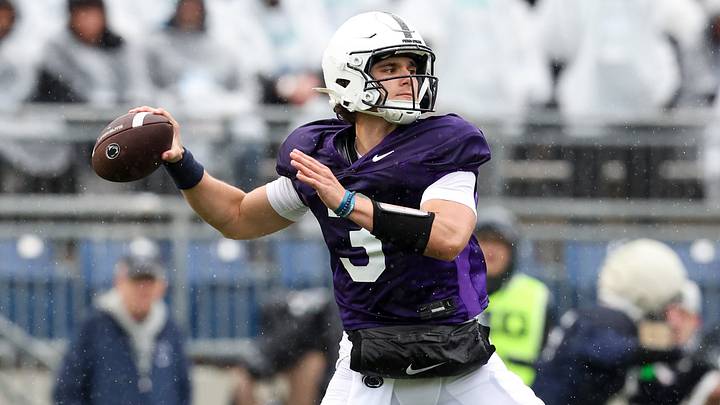
There’s so much newness in Happy Valley this year that Matt Campbell’s third-year starting quarterback, Rocco Becht, has been billed as the known commodity, a steadying force for the offense, and, for the most part, a finished product, myself included.
While there’s truth in that assessment for the most experienced quarterback in college football this season, there’s still plenty of room for improvement in Becht’s game, namely, in the situations when quarterbacks make their money: on passing downs.
And unless Becht can take a considerable step forward in that area, whether by his own volition or through the help of his play-caller, Taylor Mouser, who also came over from Iowa State this offseason, his pass-catchers, mostly former Cyclones, or both, the jump to the Big Ten could shake his steady hand.
Rocco Becht’s passing down struggles are multi-faceted, so should be the solution
Last season, Iowa State’s offense ranked No. 55 nationally in passing down success rate, defined as second-and-long, third-and-long, and fourth-down. By predicted points added, the Cyclones ranked No. 101 in the FBS (per fourthandshort.com).
Is that a direct reflection of quarterback play? Not exclusively, especially when Iowa State is one of the more run-heavy teams in college football with a -1.2% pass rate over expectation. However, when Vanderbilt with Diego Pavia, Notre Dame with CJ Carr, and Indiana with Fernando Mendoza ranked No. 1, 2, and 3 in the metric, it’s safe to say it's a reasonable encapsulation. North Texas, Ohio State, Ole Miss, and USC also ranked in the top 10, and all of those returning QBs are Heisman candidates for 2026.
So what accounts for Becht’s struggles on those got-to-have-it plays? Well, a lot of it has to do with his willingness, or rather the lack thereof, to throw the ball beyond the sticks. Becht isn’t afraid to drive the ball downfield, and he’s been a very efficient deep ball thrower.
However, most of those opportunities come either from designer play-action deep shots or from Becht picking his one-on-one matchup pre-snap and giving his receiver a chance. That’s reflected by his 7.6-yard average depth of target on dropbacks of 2.5 seconds or less, which was fourth-highest in college football. His ADOT on play-action dropbacks was 12.8.
On obvious passing downs, the threat of play-action largely goes away. And when a defensive coordinator knows you’re unlikely to throw the ball, they hold the pen; they dictate the terms. They can more easily disguise their coverage rules pre-snap, rotate coverage post-snap, and break out their designer pressure packages, making it more difficult for Becht to pick the one-on-one he likes the most.
In that sense, it’s the purest quarterback he has to play: longer dropbacks, pure progression reads, no quick-game, and no RPO. And it tends to lead to problems.
This is where it gets into the physical aspect for Becht. His mechanics are crisp when he’s hitting his backfoot and letting the ball fly in rhythm. When the picture gets muddier, the dropbacks get longer, and his footwork can deteriorate. At times, he doesn’t have the pure arm strength to drive tight-window throws when everything is perfect, so without a strong foundation underneath him, it’s even worse. As he feels pressure, it’s all or nothing - deep shots or checkdowns.
On dropbacks over 2.5 seconds, Becht’s 70.1 passer rating ranks 76th among 91 FBS QBs with 300 dropbacks (per PFF). A high drop rate from his receivers didn’t help his cause, but Becht simply wasn’t good enough to reliably extend drives. And with an offense that scored on just 82.4% of its red zone trips last year, he needed to extend drives to keep the Cyclones in games.
Rocco Becht needs a Penn State pass-catcher to become an easy-button
In Becht’s defense, he was limited by dual shoulder injuries last season, which no doubt impacted his effectiveness throwing off-platform and his comfort under pressure. He also lost two NFL receivers from the 2024 Cyclones, Jayden Higgins and Jaylin Noel.
In 2024, Becht wasn’t elite on passing downs, but Iowa State’s offense ranked No. 37 in success rate and No. 45 in PPA. That’s a meaningful improvement, and more than Becht’s health, it’s tied to Higgins, who was No. 2 in the country with 60 first downs. 75% of his catches moved the chains, and 40 of Noel’s 67 catches gave the Cyclones a fresh set of downs. In 2025, tight end Benjamin Brahmer led the way with 25.
Higgins was a big-bodied X-receiver Becht could trust to get open on third down. Brahmer is a good tight end, but he’s not equipped for that level of volume, and working in the middle of the field, it’s easier for the defense to allocate resources to take him away than a backside receiver outside the numbers.
That brings us to Chase Sowell; Penn State’s presumed X-receiver this year, as he was in Ames in 2025. The deep-threat flashes were certainly on display, but the nuances of the position weren’t to Higgins’ level. If he takes that next step, it could help Becht take that step.
It could come from Becht playing with two healthy shoulders; it may come from an improved Sowell, his second year in a power conference, or it could come from Mouser increasing the offense’s early-down passing rate to put Becht in fewer of those situations. So long as the improvement comes, Penn State will be competitive in the Big Ten.
If it doesn’t, the Nittany Lions can still make a lot of hay against a soft schedule, but will fall short in the marquee matchups against Michigan and USC. You don't necessarily need an elite QB to make the College Football Playoff. But in Year 1 of the Campbell era, with much of the roster imported from Ames, Penn State certainly will.
Becht is good, but 'elite' status is reserved for those QBs who can get it done regardless of circumstance or game script, and Becht simply hasn't cleared that bar in his lengthy career.
 Add us as a preferred source on Google