

Football is constantly evolving. Schematic evolution trickles up from high school to the NFL and back down. Right now, one of the hottest trends is heavy personnel usage on offense. Play-callers are hunting explosives, and by putting more tight ends on the field, they force the defense into a bind: match with bigger bodies and risk getting hit over the top, or stay small and get bludgeoned on the ground.
In 2025, 12-personnel (1 running back, 2 tight ends) usage was up to 23% in college football; that’s up from 17.6% in 2016, and Penn State’s new offensive coordinator Taylor Mouser is helping to lead that charge.
With a deep group of tight ends at Iowa State, Mouser practically lived in 12 or 13 personnel, and with a few of them coming over to Penn State, most notably Benjamin Brahmer and Gabe Burkle, to join Andrew Rappleyea, Matt Campbell has stated plainly that ideally, 12 personnel would be home base for his offense this year.
Increasing heavy personnel usage will have Big Ten defenses in conflict, but there are two sides to every coin. As its prevalence on the offensive side increases, so does the importance of having an answer for it on defense.
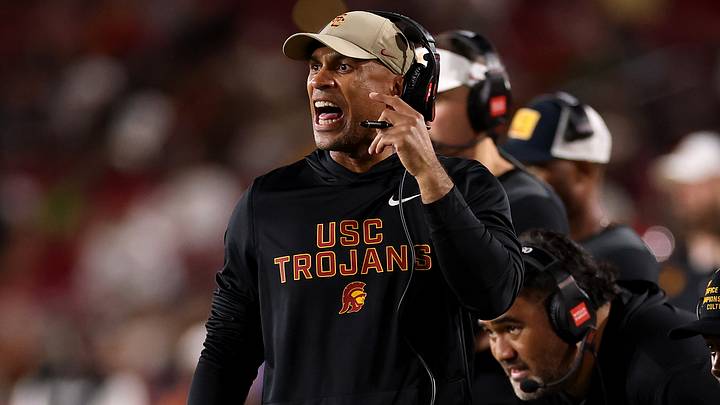
In Happy Valley, the task of finding that answer falls on former Nittany Lion D’Anton Lynn, whom Campbell brought over from USC this offseason. Lynn’s diverse man-heavy 4-2-5 scheme is a major departure from the 3-3-5 dime stack Jon Heacock ran in Ames during Campbell’s 10-year tenure. It also may not have the best solutions for increased tight end usage.
Oregon exposed D’Anton Lynn’s 12-personnel problems last season
It’s not just teams like Iowa State attempting to find an edge with a high rate of heavy personnel usage. Oregon and Ohio State were two of the most effective 12-personnel teams in the country last season, and the Ducks punished USC with Kenyon Sadiq and Jamari Johnson on the field.
Sadiq and Johnson combined for eight catches, 96 yards, and two touchdowns in Oregon’s 42-27 win, but their impact on the game expanded well beyond those touches. Just take a look at the first two plays of the game from Oregon’s now-former offensive coordinator Will Stein.
12 personnel is up, and Penn State's offense will lead that charge. But how will D'Anton Lynn defend it?
— Josh Yourish (@JYourish3) August 25, 2026
At USC loved to go base 4-3 with his 6'6" LB Eric Gentry (18) as a Swiss Army knife. That's great against the run, but watch how Oregon exploited it on the 1st 2 plays: pic.twitter.com/80WL8ctnsx
The Ducks come out in 12 and Lynn, enticed by the theoretical versatility of his 6-foot-6 linebacker Eric Gentry, matches with base. On play one, Gentry walks down, sets a decent edge, at least enough to force the run back inside, and USC has enough bodies to get the stop. But the second Stein saw base three linebackers on the field, he smelled blood in the water.
The next play was a similar formation until the two tight ends motioned out to the boundary. USC has to match them with its boundary corners, leaving Gentry one-on-one with wide receiver Malik Benson in the slot. Gentry didn’t stand a chance.
Oregon had USC in a bind the entire day, finishing not just with 42 points, but posting a 56% success rate. Eventually, Lynn started to match 12 with lighter bodies, keeping five defensive backs on the field, and Oregon pounded away, rushing for 192 yards and 0.18 EPA/carry (per gameonpaper).
Without a player like Gentry, Lynn may not attempt to play as much base into 12 personnel this year, but the real solution to this problem is in the trenches, and Penn State did the right things to try and address it this offseason.
Penn State’s supersized defensive line is the key
In the NFL, as Sean McVay and other leading offensive minds pivot to 12 and 13 personnel for the same reasons it's happening in college, the defensive trend is the big nickel: Kyle Hamilton, Nick Emmanwori, Derwin James, players who are fast enough to cover and big enough to tackle.
With Emmanwori and Devon Witherspoon, two of the most physical defensive backs in the NFL, the Seattle Seahawks did an excellent job against the Rams' 13-heavy approach. But the real key, as is almost always the case in football, lies in the trenches.
Yes, it’s great to have a big nickel who can be a force playing downhill, and with Zion Tracy, Penn State really doesn’t. However, Seattle and Mike MacDonald did such a great job defending the run from light boxes and sub packages because of the types of defensive linemen they coveted: ends like Demarcus Lawrence, who can set a hard edge, and big bodies up the middle like Byron Murphy II, Leonard Williams, and Jarran Reed, who can eat up double teams and allow the second level to play free.
That’s what Lynn, reuniting with former UCLA defensive line coach Ikaika Malloe, is trying to do at Penn State. At USC, Lynn replaced Alex Grinch, who famously valued undersized interior defensive linemen and prevented Lincoln Riley from ever winning a title because of it.
Last season, USC’s primary interior guys were 285-pound Devan Thompkins and 295-pound Jide Abasiri, who consistently got pushed around by the most physical Big Ten offensive lines. Well, not at Penn State. With Malloe, Lynn brought in four defensive tackles over 310 pounds and has a 273-pounder, Ikenna Ezeogu, working in his edge rotation.
This Penn State defensive line is going to be massive, and it should allow the defense to keep five defensive backs on the field even against two-tight-end sets. Frankly, it had better, because that’s Lynn’s best chance of finding a way to stop the 12-personnel revolution sweeping through college football.
 Add us as a preferred source on Google