

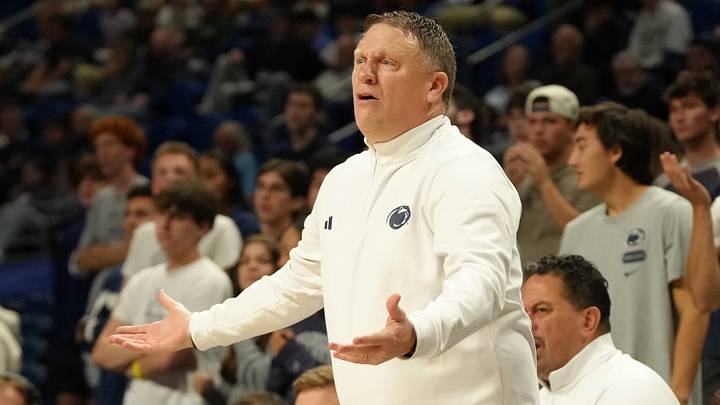
Expectations aren’t exactly high for Year 4 of the Mike Rhoades era in Happy Valley. The Nittany Lions won just 12 games last season, and despite overhauling the roster with veteran transfers and international imports, the investment level simply isn’t there for this program to meaningfully contend in the Big Ten.
Still, early in the season, it’s intriguing to see how high the ceiling might be, and while you should be cautious about drawing too many conclusions from early-season results, you can’t ignore glaring issues when they’re staring you in the face.
There were issues in Penn State’s 97-93 win over Chattanooga on Thursday night at the Bryce Jordan Center, but after nearly scoring 100 points in a win, they’re easier to wave away. Well, after the first loss of the year, falling to a Pitt team with a lame duck head coach in Jeff Capel, 82-76 at The Palestra on Sunday night, they were much more prevalent and may have been a preview of what’s to come this season.
Mike Rhoades doesn’t have a reliable shot creator
Rhoades made a big bet on Kayden Mingo leading his offense as a true freshman last year, and without a capable supporting cast around the highest-rated recruit in program history, it didn’t work. Now at Baylor, with his five-star younger brother Dylan, Kayden is starting to prove he wasn’t exactly the issue.
Still, with such a limited NIL budget, Rhoades was probably right to let Mingo walk for big money and spread around his resources in an attempt to build a deeper, bigger, tougher roster to hang in the continually supersizing Big Ten. He accomplished that with a fleet of 6-foot-7 to 6-foot-9 wings surrounding his most important returner from last season, 7-foot center Ivan Juric.
But what Rhoades neglected to do was effectively replace Mingo’s playmaking. Sure, he wasn’t efficient, but he was shouldering a huge playmaking load along with Freddie Dilione V. This year, primarily surrounded by three-and-D wings and glass cleaners in Juric and Roko Prkacin, Rhoades tasked St. Bonaventure transfer Dasonte Bowen and Central Connecticut transfer Jay Rodgers as his primary initiators. Perhaps needless to say, it hasn’t gone well.
Not every play can make the jump up from the mid-major level, and even fifth- and sixth-year vets in Bowen and Rodgers looked to be seriously limited with what they can do off the bounce against Power Conference athletes. They can’t get penetration, and struggle to create shots for themselves or for others.
Against Pitt, the point guard duo combined for just four assists and three turnovers as the entire team finished with just eight assists. As a season-long average, that would have tied Western Illinois for 365th out of 365 Division I teams a year ago.
Juric can do a bit out of the post, but primarily as a scorer, not as a creator or the modern front-court offensive hub. And while Prkacin wowed in his debut with 28 points, nearly all of it came off layups and dunks either in transition or from offensive rebounds.
That’s great against Canisius, but even against Pitt’s front court, his athletic advantage dissipated, and his lack of on-ball creation left him with limited touches and just 11 points on 4-6 shooting. With seven rebounds, two assists, and two steals in 31 minutes, it was still a good day for Prkacin, but a good day as a role player, not as the go-to scorer Penn State is desperate for.
Not all 6-foot-8 wings are created equal
As for the construction around the guards and the bigs, the theory made sense: grab as many lengthy three-point shooters as you can on the wing so you can space the floor, run in transition, and be switchable on defense. Only, like with Bowen and Rodgers, just because players are good at lower levels doesn’t mean their production is going to translate.
In the MAC, where Brant Byers came from, or DII Alabama Huntsville, where Thomas Allard starred a year ago, 6-foot-8 with a bit of shooting can go a long way. In the Big Ten, or even against a lower-tier ACC team like Pitt, if it’s 6-foot-8 with slow feet, no vertical pop, and limited playmaking, 6-foot-8 doesn’t go quite as far.
Rhoades pretty much acknowledged it in his postgame press conference:
"We have to be more physical. Last year we weren't at all. We were weak and soft and really young. We're older, we're bigger. I thought we, at times, especially on the glass, we rebounded really well today. We have to continue to do that against teams that were maybe more athletic and bigger than us... I don't think we're able to see loose balls. We had a jump ball on our basket covered and dumped it. You got to come up with that. You got to be. I thought there was a couple."
Defensively, Penn State wants to hard hedge pick-and-rolls, assuming its length can help with rotations and hold up in temporary 4-3 situations. But in the first half, Pitt feasted in the paint as Penn State was too slow to rotate and didn’t have any secondary rim protection beyond Juric.
It got so bad that Penn State had to fall back into a zone, which helped, but won’t be a reliable answer for a team that will constantly get beat down the floor in Big Ten play and already appears it could struggle to rebound.
It’s not like Pitt is a very good team
Here’s the biggest issue to come out of the 82-76 loss: Pitt isn’t any good. It just has power conference athletes on the floor, and that alone was enough to expose just about every one of Penn State’s flaws.
Maybe it will get better. Rhoades isn’t a bad coach, so he could have some schematic answers to his team’s lack of athleticism, and if his 3-and-D wings start to hit threes, it could be a different story. But the most optimistic outlook on this team, that with all the length and theoretical shooting around Juric, Penn State could jump up and play itself onto the bubble for the expanded 76-team tournament, has already been dispelled.
Rhoades didn’t have the money, and so he doesn’t have the athletes, and that’s going to show up time and time again this season.
 Add us as a preferred source on Google