

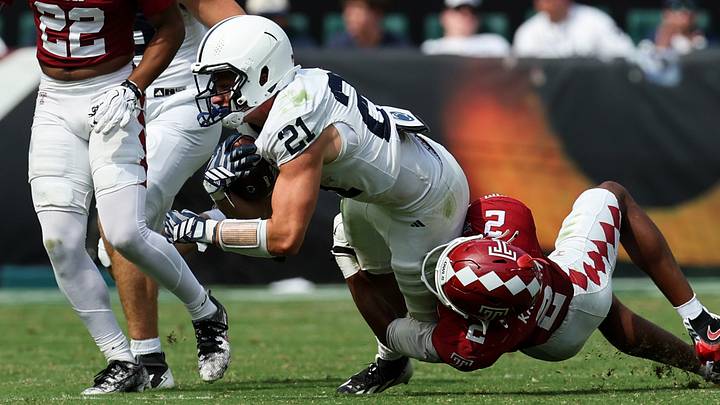
Building a run game is complicated. Anytime it struggles, the running back inevitably bears the brunt of the criticism, but the players toting the rock are not always the most responsible. Sometimes it's the play-calling, sometimes it’s the offensive line, and sometimes it’s purely circumstantial.
In Week 1 for Penn State, a lackluster ground game appeared to be a product of Marshall stacking the box against offensive coordinator Taylor Mouser’s tight end-heavy formations. So, in a 45-0 win, a 45% rushing success rate was easy to hand-wave away.
In Week 2, however, Temple didn’t sell out to keep Carson Hansen and James Peoples in check. And, in turn, quarterback Rocco Becht and the Penn State passing game didn’t produce a staggering 18% explosive pass rate. The 27-9 margin on the scoreboard may not perfectly reflect the play on the field, but Week 2 was undeniably more competitive, and this time around, a 39% rushing success rate is impossible to ignore.
Is Matt Campbell’s loyalty to Carson Hansen Penn State’s biggest problem?
Naturally, the questions began with starting Hansen, a senior Iowa State transfer who has accounted for 30 of Penn State’s 79 rushing attempts so far this year, and who toted the rock 19 times for 84 yards on Saturday.
“There were some really great Carson Hansen runs,” Campbell said when asked about his RB1 during the postgame press conference at Lincoln Financial Field in Philadelphia.
“I feel like I probably felt last week, you know? We’re like a hair off on some things and I thought there was probably good growth. I thought we were really physical at the point of attack again today, I thought that we took a step forward. But, the team that we want to be and the team that we were today is still not equal to what we want to become.”
So, Campbell isn’t putting it on his running back, which is probably closer to the truth than stating flatly that all the run-game issues would be solved by giving Peoples or Quinton Martin Jr., who didn’t play a snap on Saturday, handling the lion’s share of the carries. Still, Hansen needs to be better.
A 4.4-yard average isn’t disastrous, but Hansen has had a sub-40% rushing success rate in both games and negative EPA/carry against two non-Power Four opponents.
There haven’t been many gaping holes for Hansen to run through, but he also hasn’t done much with the running room he’s had. Most alarmingly, was kept out of the end zone on consecutive attempts inside the five-yard line after Tony Rojas’s interception in the first quarter, leading to a turnover on downs.
His biggest strength is supposed to be as a physical, between-the-tackles runner who can excel in short-yardage situations. Yet, he didn’t do a good job of that against Temple, so what will he be able to do against Penn State’s Big Ten slate of opponents, seemingly soft as it is?
Penn State should tinker with the run-game against Buffalo
Before Penn State opens Big Ten play in Week 4, the Nittany Lions host Buffalo at Beaver Stadium in Week 3. Almost no matter how you feel about Penn State after this less inspiring win, you probably expect Campbell’s career in Happy Valley to start 3-0.
A great way to maximize the advantage that is a soft schedule is to get answers about your football team in lower-risk environments. Campbell will probably tell you that Hansen is his guy, and after a near-1,000-yard season in 2025, he won’t give up on him after a slow start. Still, if for no other reason than to satiate his curiosity, Peoples and Cam Wallace, who came off the bench before Martin, should handle most of the workload against Buffalo.
If it works, it doesn’t necessarily mean that Hansen was the problem. Again, it’s Buffalo, but you need to see what this room looks like with different, seemingly more explosive, runners. You don’t want to head into Big Ten play still trying to answer that question.
Maybe it's the offensive line. Maybe it's the play-caller, but you’re not going to change those things, so change the running back for a week when there’s little to no risk.
 Add us as a preferred source on Google