

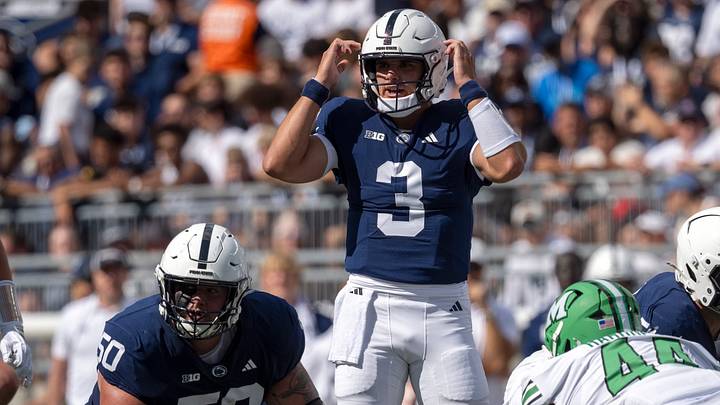
Rocco Becht had made 39 starts in college football prior to his Penn State debut on Saturday at Beaver Stadium. Yet, in those 39 starts for Iowa State, he had never thrown for four touchdowns. In his first start as a Nittany Lion, he needed just 18 attempts and barely more than a half of football to accomplish the feat.
How did he do it? Well, bringing his top five leading receivers from Ames last year with him certainly helped, and redshirt freshman wide receiver Koby Howard having his long-awaited breakout didn’t hurt either. But maybe the most important person who accompanied Matt Campbell and his longtime QB was his play-caller, Taylor Mouser, who had the Thundering Herd right where he wanted them all day.
The TE revolution is as much about the passing game as it is ground-and-pound
All over the sport, tight end usage is up. That’s not just in college, where 12 personnel was used nearly a quarter of the time in 2025; it’s in the NFL, too. In college, Mouser, who is in his third year as Campbell’s play-caller and 11th year on his staff, is helping to lead that charge. And even without his best blocking tight end, Gabe Burkle, healthy in Penn State’s 45-0 win in Week 1, he leveraged 12 personnel for an explosion through the air.
When people think about putting bigger bodies on the field, which is what you’re doing in 12 or 13 personnel, replacing wide receivers to add tight ends to the formation, they often think of doing so for short-yardage situations or to run the ball down the opponent’s throat. And that’s part of the calculus, no doubt, but oftentimes, the bigger benefits are seen in the passing game.
That’s because, by adding bigger bodies on offense, an offensive play-caller is forcing the defense, typically, to do the same. If they match tight ends with linebackers for fear of stopping the run, as Marshall defensive coordinator Brad Lambert did in Week 1 in Happy Valley, they have fewer players who are comfortable dropping back into coverage and become susceptible to big plays over their heads.
So, how did Rocco Becht average 15.1 yards per attempt, throwing for 271 yards on 13-for-18 passing? Well, because his receivers are better than Marshall’s defensive backs, but also because they had space to prove it. The space was generated by Penn State’s heavy personnel looks and Marshall’s stubborn desire to stop the run at all costs.
The Penn State run-game needs to show more eventually, but it did enough in Week 1
Frankly, the Thundering Herd did a good job of it, too. Penn State finished with a 45% rushing success rate and negative EPA/carry. That’s something the Nittany Lions would love to improve, of course, but it’s a trade off Mouser and his offensive staff would happily make if their quarterbacks, not just Becht but also Alex Manske and Connor Barry, average 12 yards per dropback with an 18% explosive pass rate.
Gameonpaper categorizes an explosive pass as a pass that generates 2.40 EPA or better. By that threshold, Becht’s explosive pass rate was 28%, which is ludicrous.
Not every defense is going to approach Penn State the same way, especially if the run game doesn’t show more in its upcoming matchups. If a defense opts to defend 12 personnel with five defensive backs, then you have to punish them for that decision on the ground.
With the talent Penn State has on offense, it should be able to do just that, but for now, Becht and the passing game holding up their end of the 12-personnel bargain is a great start to the season for Mouser.
 Add us as a preferred source on Google