

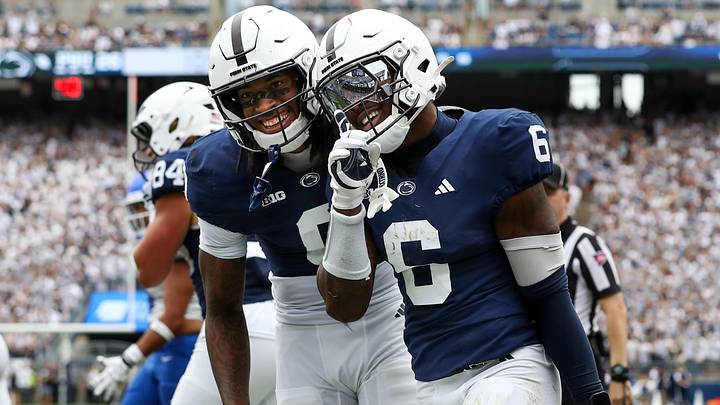
Strangely, while Koby Howard missing a month or so with an undisclosed injury is a massive loss for Penn State, it may not be as catastrophic as it would be for most offenses.
Outside of the service academies, there aren’t many offenses in college football that use wide receivers less than Penn State. Offensive coordinator Taylor Mouser wants to live in 12- and 13-personnel and has the depth at tight end to pull it off.
This isn’t to downplay Howard’s impact as Penn State’s WR1 at all. Through three weeks, maybe aside from Rocco Becht, he’s been the best player on the offense. But in a system that relies more on tight ends to log significant snaps and create its advantages, the Nittany Lions may not feel this injury the way most teams would.
Taylor Mouser will lean even more into his tight end identity
Knowing that Howard will be out for Week 4 and seemingly at least until Week 7, when Penn State heads to Ann Arbor, tight end Andrew Rappleyea being listed as questionable is even more significant.
The key to Penn State’s passing game and Rocco Becht averaging nearly 12 yards per attempt right now is that when Mouser sends out two or three tight ends, defenses are forced to match with additional big bodies, which creates more one-on-one opportunities for pass-catchers downfield. Rappleyea is a massive part of this because his presence on the field isn’t a tell.
Penn State has two other good tight end options in Benjamin Brahmer and Gabe Burkle, but both are specialists. Brahmer is a mismatch nightmare and a red-zone machine, but he’s still coming along as a blocker.
Burkle is probably the best blocking tight end on the team, but lacks explosiveness through the air. Rappleyea isn’t quite as good a pass-catcher as Brahmer or quite as good a blocker as Burkle, though he’s close; he’s a better blocker than Brahmer and more dynamic than Burkle, so his impact is much greater because defenses don’t know what to expect.
You can generate a similar effect by playing Brahmer and Burkle together. Finn Furmanek, who has just one catch this season, would be the most likely run-tell. But if Rappelyea can go this week, he’ll likely be the linchpin of the game plan, forcing the defense into a conundrum that often results in one-on-ones for the one or two wide receivers on the field.
Even if it's not Howard, Chase Sowell and Brett Eskildsen have shown enough playmaking ability in their careers for Becht to continue pushing the ball down the field. While most of the targets are not necessarily funneled to the tight ends, Mouser’s passing game is built around their presence more than it is on having a dominant No. 1 wide receiver, which he probably wasn’t certain Howard was heading into the year.
Penn State can ‘moneyball’ a Koby Howard replacement
There is no other player on Penn State’s roster who can do all the things Howard does well. He can separate underneath from the slot, stretch the field vertically, win contested catches, and with his thick frame, he turns into a running back after the catch.
There’s also no other player Mouser will likely feel comfortable using as the gadget guy, motioning into the backfield and getting designed touches on reverses. That’s probably the biggest loss, but as the Oakland A’s did when Jason Giambi left in 2002, Penn State can recreate Howard in the aggregate.
Howard’s slot reps will go to Zay Robinson, who may even be quicker underneath than Howard, but who hasn’t shown the vertical ability and contest-catch chops just yet. On the outside, it’ll likely be Sowell and Eskildsen, both downfield threats capable of taking the top off a defense.
As with Rappleyea, there’s value to having a complete player who can threaten both aspects as a receiver, but in the meantime, Mouser will have to make do buy cobbling together his No. 1 wide receiver from his three most talented Iowa State transfers.
And because the scheme is built around the tight ends and the quarterback has more experience than anyone in college football, whatever regression the offense feels in the next three weeks will more likely be tied to the uptick in competition rather than the loss of its best player.
Penn State is better with Koby Howard; that’s inarguable. But it's also better equipped to lose a player like him than most teams would be.
 Add us as a preferred source on Google