

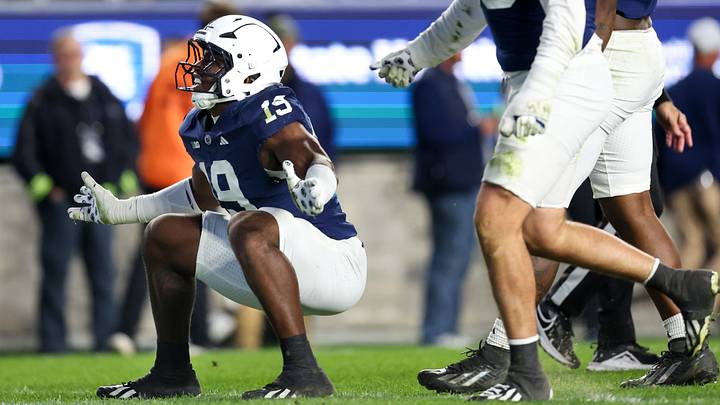
The way Penn State was playing heading into its Week 9 bye at 0-4 in Big Ten play, it wasn’t inconceivable that Purdue could come into Beaver Stadium and pull off another upset. Instead, Penn State handled business and proved that, in Matt Campbell’s first year, the program hasn’t sunk quite that low.
Now, with a favorable back half of the schedule starting off with a trip to Washington in Week 10, it’s also not inconceivable that Penn State could rattle off five in a row and finish out 8-4. After Washington, the Nittany Lions host Minnesota and Rutgers before traveling to Maryland.
But even with that soft schedule, 8-4 is probably only possible if the improvements that Penn State put on display in Week 9 were real and not just Purdue.
It’s not that Purdue is the true dregs of the Big Ten. Maryland and Rutgers are holding down that distinction this year. The Boilermakers have been frisky at times this year. But they’re also clearly the worst team Penn State has played since Big Ten play started, so it’s worthy of investigation.
Strangely, nine weeks into the season, it feels like a uniquely small sample size to judge from. Penn State made meaningful schematic adjustments in the off-week and shook up the depth chart just as much, so it’s not particularly easy to discern how much to take from Week 9 and spin forward the rest of the way. Until we see Penn State play Washington, a team
Real: The run-game scheme change
Penn State, as a run game and, really, as an offense, had diversity without identity. It’s good to have a variety of different weapons, pass concepts, or run schemes to go to, but if you don’t do anything particularly well, everything looks like a changeup, and without a fastball to speed a hitter up, a changeup can be fairly easy to hit.
That was Penn State’s whole offense, but especially the run game, constantly toggling between the zone run game, which most of the running backs are better equipped for, and the gap scheme run game, which is a better fit for the offensive line. On the bye week, the zone run game was almost completely stripped away in favor of duo (a gap scheme run without any pullers that looks a lot like inside zone but isn’t), power, and counter. It worked brilliantly.
Swapping in Cam Wallace also helped. Not just because, as Matt Campbell has said since his breakout, he was playing so well in practice and brought that to the game, but because his patience and vision as a runner are something one-cut-style runners like James Poples and Quinton Martin Jr. have not displayed.
This is a power run game from here on out. Offensive coordinator Taylor Mouser has his O-line and tight ends working double teams for 20 minutes straight every practice, so hopefully, with this newfound identity, the production continues to be at a high level.
Just Purdue: The run-game efficiency
This is the important question. We know what Penn State is going to do on the ground, but how well is it going to work? Probably not as well as it did in Week 9.
Penn State managed a 49% rushing success rate and four explosive runs against Purdue for 0.17 EPA/rush. Those aren’t unsustainable, off-the-charts numbers, but they’re way up from Penn State’s season averages coming in.
Part of that is a Purdue run defense that now ranks No. 101 in rushing success rate, No. 126 in EPA/rush, No. 128 in stuff rate, and explosive rush rate. Which is to say that, as a run defense, Purdue isn’t just bad; it’s abysmal.
Is Penn State's run game fixed, or did it just play Purdue? For as promising as Cam Wallace's day was, this graph points to the latter: pic.twitter.com/Yj75krdnru
— Josh Yourish (@JYourish3) November 4, 2026
Real: Secondary’s dominance
Lost in Penn State’s dominance, largely because it controlled possession for more than 43 minutes, is how comprehensively D’Anton Lynn’s defense stifled a Purdue offense that ranked No. 42 in success rate and No. 34 in explosiveness.
Quarterback Ryan Browne has been legitimately good this season, and against Penn State, he went 10/29 for 154 yards, a touchdown, and two interceptions. That’s a 35.0 QBR, a 30% dropback success rate, and -0.15 EPA/play. Penn State’s 99th percentile havoc rate performance relied heavily on the six pass breakups and two interceptions the secondary forced.
Audavion Collins is a superstar, and Daryus Dixson might be too. That duo is legitimately great, and Terry Smith has talent coming up behind them at the position. With Zion Tracy playing a lot more at safety, all the pieces fit together much better.
Just Purdue: Defensive line production
Penn State’s defense generates one of the lowest pressure rates in the country, despite Lynn’s willingness to dial up pressure. Now, Lynn turned that dial up even more against Purdue, blitzing at nearly a 50% rate, which was risky against an offense that largely hasn’t been blitzed this season and has thrived when it has been. Still, the production he got from his defensive front probably isn’t replicable, at least not every week.
Among Big Ten quarterbacks, Browne has been pressured at the fourth-highest rate this season (35.3%). Penn State pressured him less than that, at 32.5%, so relative to its peers, Penn State underperformed despite Yvan Kemajou and Caleb Bacon both racking up three QB pressures apiece.
Penn State just doesn’t have enough juice along its defensive line. Kemajou has potential, but even he is more of a physical pocket-pusher. Max Granville was supposed to be the primary penetrator off the edge, and he’s been out with an injury nearly all season.
The talent isn’t there for that uptick to be sustainable, but it might just translate to Week 10 because the most pressured QB in the Big Ten is Washington’s Demond Williams at 41.3%.
Real: Development
This coaching staff had success at Iowa State and was brought over to Penn State because they’re great developers. Now, if that’s all they do, they won’t be successful at the level they need to be in Happy Valley; let’s be clear about that -- but even through the bumps of this season, they’re showing how they got that reputation.
Whether it’s Campbell leaving room for Wallace to bubble up to the top of the depth chart with his borderline dogmatic, you have to earn your playing time, mindset, or Mouser talking about how he spent the bye week working on the fundamentals of double team blocks, this staff is about coaching.
Campbell basically said as much when describing the proclivity of coaches to want to scheme their way out of problems, rather than coaching their way out of them. That’s real, and there’s a ton of value to it.
Again, if they don’t get enough elite talent on this roster, it won’t matter, and this hire will look like a mistake, but for now, it’s encouraging to see this under-talented roster continue to get better throughout the season.
 Add us as a preferred source on Google