

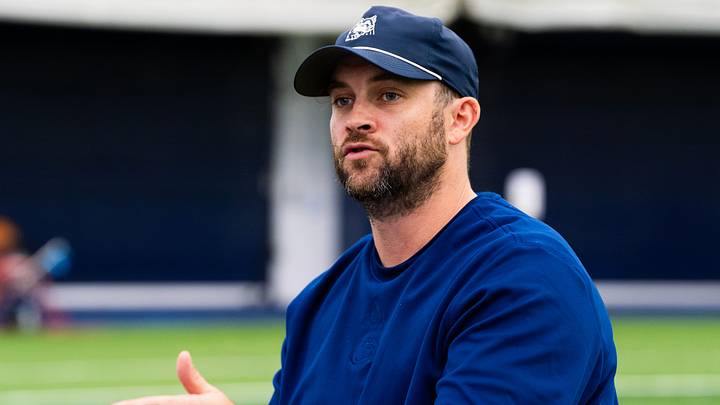
Through six weeks, Penn State’s offense ranks No. 76 in success rate, No. 46 in points per drive, and in its three Big Ten losses, the Nittany Lions offense has averaged 16.3 offensive points per game.
The unit led by Matt Campbell’s third-year offensive coordinator Taylor Mouser scored just 23 points against USC’s dreadful defense in an eight-point Week 6 loss to fall to 3-3 and remain winless in conference play, but the fanbase’s ire shouldn’t be directed at the play-caller.
Frankly, Mouser is doing what he can to make chicken salad out of chicken...you know what.
Penn State's offense is not good, but we can't throw the baby out with the bathwater. Taylor Mouser is a good OC. He just doesn't have Big Ten talent.
— Josh Yourish (@JYourish3) October 12, 2026
-created leverage for his receivers
-moved the pocket for Becht
-schemed up explosives (even if they didn't all hit) pic.twitter.com/F6voVkY9Gd
Taylor Mouer pulled all the right levers for Penn State’s passing game vs. USC
With Koby Howard out, Penn State simply doesn’t have a pass catcher who is a difference-maker at the Big Ten level. Tight end Benjamin Brahmer is a nice red zone weapon, and Chase Sowell can make a few plays with his speed, but their skill set is better suited to the Big 12. They’re average Big Ten players at best.
Because of that, Penn State saw a lot of man coverage the last two weeks in losses to Wisconsin and Northwestern. Mouser seemingly suspected he’d get more in from USC defensive coordinator Gary Patterson, which he did in the first half, and he was ready for it.
Penn State did an excellent job of creating leverage for its receivers by utilizing pre-snap motion, bunch formations, and downfield rubs and picks. Mouser made it hard for USC’s corners to disrupt Penn State’s releases with his formations, often protecting his receivers from press, and found easy-access throws for Rocco Becht, who undeniably had his best game against Big Ten competition this year.
The Andrew Rappleyea touchdown in the first half is the perfect example. Pre-snap motion allowed Becht to identify the man coverage, then Rappleyea, who was the tightest to the line of scrimmage in a field-side bunch formation, leaked out on a wheel route as Brett Eskildsen and Benjamin Brahmer tied up the outside defenders, and Rappleyea waltzed in for a score.
Man coverage, however, wasn’t the only problem Mouser needed to solve in the passing game; he also needed to get Becht clearer throwing lanes after two weeks of tipped balls and interior pressure from an overmatched center and left guard.
Again, Mouser had a clear answer. He got Becht on the move a lot more, changing the launch point for his diminutive quarterback, which manufactured both easy throws and explosive plays. It was a really impressive game plan for a coordinator who is handcuffed by the dearth of talent on his unit. But eventually, he bumped his head on those limitations.
Talent limitations have a hard ceiling on the Penn State offense
So, if Mouser is so good, why did Penn State score six points in the second half? Well, for one, it got just four possessions, and one ended with an Eskildsen fumble on what would have been a drive-starting explosive play. But the other reason is that there just isn’t a lot of talent for Mouser to work with, and you can only game it for so long.
Against a run defense that ranked No. 119 in rushing success rate coming in, the Nittany Lions ran for 2.2 yards a pop and just 68 total yards. Patterson realized Mouser had the edge when he was playing man, so he went into a two-high zone shell. Mouser got light box looks with an increase in spread formations, creating the ideal conditions to run the ball. Penn State still got whipped up front.
There’s only so much Mouser can do with Brock Riker at center and Trevor Buhr at left guard. Both are unplayably bad, and there seemingly isn’t anyone behind them on the depth chart worth trying out. Then, without Howard, Penn State doesn’t have a real YAC threat to scheme touches for against the two-high shell, so Mouser has to ask Becht to sit in the pocket and consistently hit throws with high-level accuracy, and he’s just too streaky.
Maybe Mouser finds a solution for the two-high shell that Penn State will undoubtedly be seeing more of, but even then it’s incumbent on his offensive line and quarterback to take advantage of the opportunities he creates. That probably won’t happen enough to make anyone feel good about the offense heading into the offseason, but that shouldn’t heat Mouser’s seat.
Penn State needs real Big Ten talent. Matt Campbell and general manager Derek Hoodjer have to find some in the transfer portal this offseason. Once they do, Mouser’s offense can start producing at a level commensurate with his impressive play-calling chops.
 Add us as a preferred source on Google