

Penn State is 0-3 in Big Ten play and 0-5 in the five highest-attended games in Beaver Stadium history. Saturday night’s 31-23 loss to No. 19 USC broke the attendance record and sent the 114,419 who packed the house home unhappy.
Any thought of rallying to threaten for a College Football Playoff bid is now far out of mind, and heading to Ann Arbor next week, Penn State is far from a lock to make a bowl. In what already feels like a lost season, let’s take a look at a few winners from Saturday night and more than a few losers on the Penn State side.
Winners
3. Zion Tracy
Zion Tracy has played all over Penn State’s defense through the last three seasons and three different coordinators. Now, it seems he’s going to settle into a role at safety, allowing Josiah Zayas to play nickel full-time as a true freshman. Tracy acquitted himself well in his new position with five tackles, a half TFL and a pass breakup. He’s probably the best coverage player Penn State has at safety.
2. Rocco Becht
Matt Campbell was earnestly asked about going to Alex Manske after Week 5. Eventually, if Penn State keeps losing, he’ll need to, but for now the most experienced quarterback in college football looks deserving of his starting spot after throwing for 289 yards and a touchdown, and averaging 9.0 yards per attempt.
Becht is far from an elite Big Ten QB. He’s probably not even an upper-half Big Ten starting QB. But he was serviceable and was probably the best player on Penn State’s offense in Week 6. With the dearth of talent on this roster, especially with Koby Howard out, that’s what the Nittany Lions need him to be.
1. Taylor Mouser
Taylor Mouser has been much-maligned for Penn State’s offensive struggles, but it’s hard to lay most of the blame at the feet of the play-caller when the quarterback was playing as poorly as Rocco Becht was and the offensive line was as consistently overmatched as Penn State’s was.
Still, the play-caller has to find solutions to those problems, and though Penn State finished with a meager 38% success rate, I thought Mouser did an excellent job of pulling the necessary levers to help his quarterback, his offensive line, and his receivers.
He leaned into spread formation, pre-snap motion, and getting Becht on the move to avoid batted balls. He gave Malachi Goodman more help at left tackle and helped create separation for his receivers. Mouser did what he could, even if the numbers are going to look ugly against one of the worst defenses in the country.
Losers
5. Marcus Neal Jr.
Neal was the fourth safety off the bench against Northwestern after starting most of the season; against USC, he didn’t play a single snap. Neal has been a problem in coverage and not a good enough tackler as a box safety, so it seems he’s out of the rotation entirely. He was not on the injury report.
4. Josiah Zayas
Josiah Zayas left the game with an injury in the fourth quarter, but he ultimately returned, so that’s not the reason he’s made this list. No, Zayas made the losers list because he got his first clear opportunity to play the lion’s share of the snaps at nickel with Zion Tracy moving back to safety, and he was clearly outmatched by USC true freshman Trent Moseley. Moseley caught nine passes for 111 yards and a touchdown.
3. D’Anton Lynn
There are only so many levers that D’Anton Lynn can pull with this defense: He has no reliable pass-rusher to build his pressure packages around, he has a bulky defensive tackle room that can’t hold up against double teams, and he has a MIKE linebacker in Kooper Ebel who seemingly can’t tackle.
So, Lynn is probably out of options with this unit, honestly. Still, for all the talk of him potentially being familiar with Lincoln Riley’s offense from his two years at USC, the Trojans punted twice and had a 92nd percentile EPA/play output.
2. The run game
USC ranked No. 119 in the country in defensive rushing success rate coming into this game. Yet, Penn State rushed for 68 yards on 31 carries, with 28 from Carson Hansen, who carried it 14 times. There isn’t a quality Big Ten running back in this backfield, and there is one above-average Big Ten offensive lineman on this team right now: Anthony Donkoh.
1. Matt Campbell
Multiple times in the game, and particularly in the second half, Penn State substituted late on offense, allowing USC to respond with its own substitutions, draining the play clock and forcing Matt Campbell to burn his timeouts.
Then, in the fourth quarter, facing a fourth-and-4 from his own 13-yard line, Lincoln Riley ran out a formation with Jayden Maiva in the shotgun and his punter, Lachlan Carrigan, split out in the slot. It didn’t appear as though USC was willing to actually run a play, but it was a bizarre enough formation that Campbell was forced to burn his timeout, which is exactly what Riley wanted.
As the icing on the cake, Penn State was flagged for a delay-of-game penalty on third-and-3 with 1:09 left and no timeouts for trying to draw USC offside.
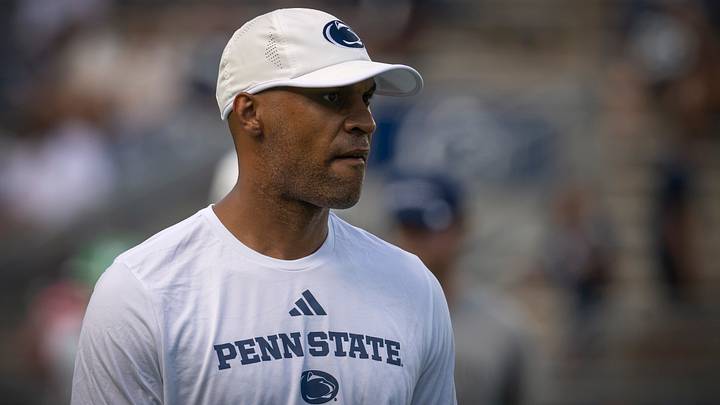
Penn State responded from its blowout loss to Northwestern last week and is definitely a less talented team than USC, but once again, Campbell got outcoached, at least in terms of game management. He was aggressive on fourth downs, which was nice to see, and his team didn’t get run off the field, but he’s yet to inspire confidence.
 Add us as a preferred source on Google