

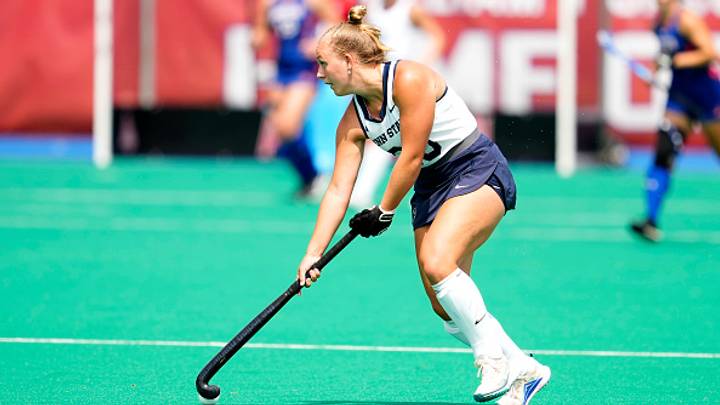
During the spring of 2024, senior Anouk Knuvers, like everybody else on the Penn State Nittany Lions Field Hockey roster, was eagerly looking ahead toward the fall season.
In Knuvers’ case, it was supposed to be her last. She was looking forward to her senior year and continuing to solidify herself as the team’s defensive anchor, one who had emerged as a starter as a freshman in 2021 and played a key role in the team’s Big Ten Championship and subsequent run to the Final Four the following year.
Even with her primary role on defense, she continued to pursue her first goal, after having scored her first career points via three assists as a junior – and having taken her first shots on goal that same season.
Everything was going as planned.
But just like that, everything changed in the annual alumni game.
“I remember I just took a turn, and I felt something,” Knuvers told FanSided’s Victory Bell Rings. “I was like, ‘oh, shoot; this is not good.’
“The way it happened was really unfortunate. I did my whole ‘last spring’, because basically your junior year, you do your last spring and then you play in the fall and then you don’t have to do the spring again in your senior year. So I went through the whole spring, celebrated my last spring practice, my last spring conditioning, etc.”
It didn’t take long to confirm the worst-case diagnosis, and to confirm that the Dutch star would have to miss her senior season entirely.
“It immediately swole up,” she recalled. “I got an MRI, got everything, and they told me I tore my ACL, and then when they went in for surgery, they told me I also tore my meniscus on both sides. So I was already looking at like nine months, but I had an extra month because of my meniscus.
“It’s like the worst injury you can have as an athlete, the longest [recovery] there is. I was just so set on that next year was going to be my last year, and I was confused. I was panicking, like, what am I going to do? I was set to graduate next year, and everything was fine; I played my four years. I was going to play my last year. I was going to graduate in the same year.”
She didn’t know what was next. Thousands of miles from home, on the other side of the globe, the native of 's-Hertogenbosch faced an uncertainty she never thought she’d face when she decided to move from the Netherlands to Penn State to attend school and play field hockey. She didn’t know for sure if she’d ever see the field again.
“One thing I remember is I was glad I had the summer so I could go home,” she said of the timing of the injury. “It was kind of, do I go home and recover for my first couple of months there and then come back, or do I stay in the U.S? I’m glad I got the time to go home and sit back and be by myself with my family.”
A few months later, the start of the regular season rolled around, and No. 20 was forced to watch from the sidelines.
“When I came back, obviously that’s when it hit me that I wasn’t playing, because that’s when you get back to training, you see the girls working out, you see the girls getting ready for preseason, the first game, the first scrimmage,” she remembered. “That’s the hard part; that’s when it really hit me that this was going to be a long time, because at that point, I still had like six months to go.”
After devastating injury, Knuvers pushed forward in new role
But perhaps the most important dilemma Knuvers faced, as she continued to navigate a career-altering obstacle, was not the process of recovery in and of itself. It was the decision to be bitter, or to be better.
She chose the latter.
“That was definitely tough, but I had some conversations,” she said. “I remember I talked to my parents, and I talked to someone from the psychology department. I wanted to be helpful in any way that I could.
“I was a senior and I had a lot of experience and I could sit there and be mad about this and be upset, but that wasn’t going to help anyone, and it was going to make it a lot harder for not only them, but for me too, to sit there and sulk the entire time. I decided to do whatever I could do with videos and meetings, and I’d try to help the girls on the sidelines.”
It helped that one of her teammates was also dealing with an injury at the same time, which gave both somebody to lean on.
“One of my teammates, Hannah [Schreckengaust], and I had surgery probably three weeks apart,” Knuvers said. “We kind of went through the whole thing together, which helped me a lot because there was someone there who was going through the same things that I was. We did a lot of rehab together. It’s just nice because she was also on the sidelines.
“She had the same struggles mentally about how hard it was being on the sidelines not playing. Because sometimes you do want to complain, and sometimes you do, and that’s natural too. People have always said that you want to protect the girls who are playing; you don’t want to bring them down. But my parents also said that you can accept that this does suck and you’re allowed to feel that way. It helps if there’s someone around you going through the same thing."
While she wasn’t active on the field, her presence was still felt on the sideline, in the locker room, and during practice and other team-related sessions.
But part of making that presence felt came with accepting the reality that, as much as she wanted to be out there on the field helping the team, that was simply not realistic at that point. Her role needed to adjust, and she made that adjustment.
“I tried to be there for the freshmen in any way that I could,” she said. “On the other hand, you just keep your head down and you try to work as hard as you can to get back as fast as you can, but obviously I knew I was going to be out for the entire season. There was no way I was going to get back before that.
“The coaching staff was really understanding. They tried to include me in everything that they could. They asked for my help a lot, which is just nice because then you don’t feel like you’re on the side. You’re still working with the team, you’re still doing everything.”
The 2024 season ultimately ended in disappointment for the Nittany Lions, which saw a 30-year streak of qualifying for the Big Ten Tournament come to an end due to a standings tiebreaker with conference rival Iowa.
But when the sun set on the evening of Friday, November 1, 2024, Knuvers knew it was finally time to refocus. Because the next time the Nittany Lions took the field, she wanted to be one of the 11 girls with a stick in her hand.
“In the spring, it’s just working toward that final test that you have to do,” she explained. “That’s when the hard part begins, because you can basically do anything else except play field hockey, which is really frustrating because you’re like, ‘okay, I can do everything else, but I just want to play.’”
Gaining perspective amid an unforeseen obstacle
One thing she did get to do that spring was graduate from Penn State, with a bachelor's degree in marketing. It allowed her to place even more of a focus on getting back to full health to focus on her final field hockey season just a few months later.
“I just remember I was so relieved when they told me I was cleared, that I could play,” she said. “I remember being really grateful.”
But that gratitude wasn’t just about being able to play again; it was ironically a gratitude about the circumstances which allowed her to get back, and with a fresh mindset that would not allow her to take anything for granted moving forward.
“I think because of how much we train and practice and everything revolves around field hockey, you get tired sometimes, mentally and physically, and I think this, in like the weirdest way, was like a reset of how I’m really grateful and I really do love this sport that I was so eager to play again.
“It’s kind of like a reset of your energy in a way, which was odd for me because at the beginning, it sucked so much, but now it turned into kind of like a good thing in disguise; I had more time. I was less tired. And I was mentally ready to play my last season.”
While the injury itself may have cast doubt on her playing career, Knuvers herself never had any doubts that she had what it took to get back on the field.
“I was lucky that I didn’t really have complications throughout my entire process of recovering,” she recalled. “I went through the whole thing pretty much in one go. I think it was after 10 or 10 and a half months when I got cleared, which is basically on time. You can do your first testing at nine months; that’s just the mark.”
But of course, being a Division I athlete, she naturally wanted to test the limits at first.
“I remember I wanted to do my testing too early, and they pulled me back, and they said they knew I could play, but they didn’t want me to take the risk because I didn’t have to be ready for another four months,” she said. “They’d rather I took another month. And I remember being so mad. I was like, what do you mean another month? And they said, it’s just another three weeks.
“But I was like, ‘I’ve been doing this for I don’t know how many weeks now, and it’s been like nine and a half months; I want to play right now!’ I remember being so mad and upset. It was so frustrating because I was so close. My athletic trainer, Rebecca [Hall], at the time – she’s amazing. She said, you know what? We’re just going to set a goal. We’re going to do it again in three weeks, and you’re going to make it.”
She made it.
“I said, ‘I’m doing this one more time and then I’m playing. I really don’t care!’ So we set a goal, and three weeks later, I was cleared. I feel like that was the only setback I had, but not anything physically throughout the process where I felt like I couldn’t get back.”
It was a challenge, but as she navigated that challenge, it came with an additional appreciation for the game she wanted so badly to return to as quickly as possible.
“In my position, I would play full games; I would play the entire 60 minutes,” she said. “So you don’t really get the opportunity to go to the sidelines and see the game from the sidelines. What I noticed is how coaching works. I think you just learn to help your teammates in a different way once you’re on the sidelines because you can't physically contribute to the game.
“There are so many other possibilities to help girls on the team, girls on the field, girls who are not playing, girls who are playing. There’s so much more that goes into what happens on the field come game day that you often take for granted, and you don’t really look at that when you’re playing. Then when you’re not playing, but you’re trying to help the people who are playing, you kind of take that into consideration.
“You get a different perspective on the game, and some things can get really heated – I'm especially known to get heated in a game because I get stuck on stuff!”
Knuvers’ passion for the game is unmistakable, and that heated side could be seen on more than one occasion even in 2025, after she finally made it back.
“I definitely got it from my dad,” she admitted. “My dad’s the same way. We're so heated; it’s why we can’t play games together because we’ll actually get so mad! But I think it’s something that’s just driven me to get to the places I have gotten, with field hockey and with everything I have done so far, not just on the field but off the field as well.
“I feel like in a game, I just get so sucked into the game itself, like the fact that you can win or lose, especially in the States; you don’t tie. At home, you can tie, and in the U.S., you can’t tie. It’s win or lose. I get so sucked into the game because I want to win; I hate losing.”
Knuvers' humility characterized by approach to team captain honor
Underneath the fiery surface, it really is just a team-first mentality.
“I can play the worst game of my life, but if we win, I’ll be happy,” she continued. “I can play the ugliest game of my life. If we win, I really don’t care. Sometimes in certain games, it gives me some extra energy. When I feel like I'm totally burned out, when I’ve played an entire game and it comes to overtime or something like that, it gives me that extra edge.
“I’m gonna push an extra 10% because I'd rather die on this field and win than lose. In that way, it makes me passionate because it's the small things. It’s one call that can decide a game sometimes. It’s one bad play that can decide a game sometimes. It’s one corner that can decide a game sometimes. I get really stuck on those things.”
That team-first mentality is one of the reasons why her personality was fully embraced by her teammates, who voted her, along with Sophia Mannino, to be a team captain ahead of the 2025 season, even after she hadn’t played in a game since November 2023.
“It’s an honor, first of all,” she humbly stated. “I was honored that I got to do that for a year. I was extremely grateful and honored that my teammates were confident that I could do that. In the end, by the time my senior year came around, that was a goal of mine. It was something I really wanted to do. But it was hard when I hadn’t played for a year, obviously.
"I think in the way that I play, it doesn’t really matter. It is just a title for me because whether or not I would have been captain, I don’t think it has ever changed the way that I play and the way that I present myself to my teammates or the way that I present myself on the field.”
It’s that exact unselfish approach that made her an ideal captain in the first place.
“I’ve been as fiery as I was without that band as I was with the captain’s band,” she said. “For me, it doesn’t matter, but it’s just an honor. It doesn’t change the way that I act, and it doesn't change the way that I play or how I treat my teammates or anybody else.
“It comes naturally to me to be a leader on the field. I’ve always been like that, and it was just an honor that my teammates felt confident enough to give me that title – and my teammate Phi, obviously.”
As Knuvers suited up to return to the field for the first time in nearly two years, she felt something she rarely ever felt when playing the game she had known for more than a decade and a half: nervous.
“I remember the first scrimmage, I was allowed to play like five minutes a quarter, and I remember being so nervous, and I don’t really get nervous before playing games because it’s the same game I’ve played so many times.”
It took a hug from head coach Lisa Bervinchak Love, after Knuvers’ first five-minute stint in the lineup, for her to realize what she had been waiting around 16 months for: she was indeed back.
“I was so nervous and I played and I came off the field, and LB was waiting, and she hugged me and told me she was so glad I’m back,” Knuvers said. “That’s when I was really like, ‘I’m allowed to play again.’ I was just really happy and really grateful, and I was really grateful that she wanted to celebrate that with me. That was really special. And then obviously once you get back and you start doing preseason again, that’s when you really feel like this is for real again.
“But I feel like that first scrimmage was the first time I was like – oh, damn, I’m really nervous!”
Anouk Knuvers' first goal was 'just really funny'
From the onset of her return, Knuvers made her defensive presence felt, just as she had during her first three years in the lineup. But continuing the trend of getting more involved in the offensive gameplan, just as she was during her junior season two years prior, she finally did something she had never done before: scored a goal.
“This is funny, because I feel like I always said I have to score at least one goal before I leave,” she said. “In practice, I would like to go up and mess around sometimes and try to score, but it never happened in a game. I don’t remember who I told, I think it was Ally [Hammel], that I’m going to score this season – 'watch it; I have to before I leave!'”
It was a huge goal, and it came in the team’s third game of the season. It was an unassisted goal during a penalty corner opportunity to go up 1-0 against the Saint Joseph’s Hawks, which had beaten Penn State the previous season en route to a National Championship Game appearance.
Penn State ended up winning that game 2-1 in overtime, marking the first time the Nittany Lions had beaten a team from the previous season’s National Championship Game since 2021.
“When that happened, it was really funny that it happened right now,” Knuvers said of the significance of the goal. “It was special. It was something I really wanted to do before I left. It just felt weird because everyone’s so excited – because I never score! Everyone’s like, ‘oh my gosh, you scored!’, and I’m like, this is just really funny. It was like a joke within the team.”
The fact that it happened after the injury made her appreciate it that much more, adding yet another pillar of perspective to a journey that had already taught her a ton about herself.
“In a way, scoring a goal like that is a way to contribute to the game and the team, which in the end is what you try to do every game,” she noted. “I do think it was special considering that I had never scored and it was my last season and it was my first season coming back from an injury. It was just a way to showcase that I had worked really hard to get back to where I was before the injury.”
She admitted that she could sometimes struggle with trying to live up to others’ expectations for her, so being able to do something she had never done before, and in such a consequential manner, was huge for her own confidence as the season progressed.
“There’s a certain expectation you have for yourself, but also other people have for you,” she said. “I think that’s something I struggle with. I was a starter when I left for my injury, and to come back, I felt like I had a certain expectation to uphold.
“I was performing at a certain level before I had my injury and I felt like if I couldn’t make it to that level, I was letting people down and letting myself down, in a way. So scoring was a nice way of being like, okay, I’m back to where I was.”
In a way, she was ahead of where she was. She was back to being a full-time starter, back to leading the team in minutes, and now contributing in a way she had never contributed before.
Knuvers embraces Penn State 'family' mentality during final season
Unfortunately, she did re-injure her knee about two-thirds of the way into the season. After starting the first 12 games, she came off the bench and played limited minutes in three of the final five.
She still finished the season tied for fourth in the Big Ten in defensive saves, and two of the three athletes who finished ahead of her started every game.
While the 2025 team ultimately also fell just shy of a postseason appearance, she reflected on just how special that group was, specifically in terms of its camaraderie.
“I’ve never been on a team that is as close as the team I was on last year,” she said without hesitation. “Something that’s really special, we talk about family at Penn State and especially Penn State field hockey, we call ourselves family, but those girls, we did everything together. We were so close, and I think it showcased on the field. We are very close, and everyone played like it was just very special.
“I had never really been on a team where it didn’t matter if someone was a senior, it didn’t matter if someone was a freshman, it didn’t matter if someone played an entire game, it didn’t matter if someone didn’t play. It really didn’t matter; everyone was really close. Everyone gave their all at practice. It was very open and very caring. People were happy for each other when they did well. People tried to help each other throughout the season. I think that was very special.”
Knuvers left State College with no regrets.
“It was a mix of emotions, obviously, because I would have loved to play my last home game knowing that I was going to play in the Big Ten Tournament,” she recalled, regarding the moment the clock hit 0:00 in Penn State's season-ending 4-2 loss to Rutgers.
“Along with the feeling of, hey, this is my last game I play here at Penn State, it was also, hey, this is my last game I’m playing for Penn State, and maybe this is going to be my last game playing field hockey, period.”
As she struggled to leave the field, all the memories came rushing back to her, including all the lessons she learned from those long months when she was forced to take everything in from the sideline.
“I was really overwhelmed, I remember, because on one hand, you’re grateful and proud of everything that you’ve done; for me, it’s been five years,” she continued. “You kind of go back to like the first time you stepped on the field and you were super nervous, when you’re like, oh, what’s happening?
“Then now it’s like, I'm standing here right now. I’m a captain. I have won the Big Ten. I have gone to the Final Four. I have experienced so much over the course of five years. That hits you. Then on the other hand, there was the human and the sports part of it, where I was like, I’m really mad and really upset that our season’s over and we lost.
“You want to end on a high, so it was a mix of emotions. I was proud and grateful and I was sad and angry. Everything came together and I just remember standing on the field. I was like, I don’t know if I can leave. I just want to sit here. It just felt weird.”
Knuvers has high hopes for Penn State in 2026, and for good reason
Knuvers says she plans to continue following the team, even though it may take some sleep schedule adjustments or game recordings to be able to do that on a regular basis from the Netherlands, where she is planning to move to Amsterdam in the not too distant future.
Her number one hope for this group is that they get to experience the postseason this coming fall. The current roster has just nine total minutes of postseason experience.
“It’s what you work for,” she said. “I think it’s what we have worked for every year that I’ve been at Penn State. It’s always a goal of ours, and sadly they haven’t gotten to experience that yet. But it’s really special. When you start in August, that’s your goal come November. It’s just a testament to all your hard work and all the hours you put into it.
“We go into this bubble and really only focus on field hockey and school. You don’t really have time for anything else. It’s just so rewarding to get to a Big Ten tournament, to win a Big Ten conference, to get to the NCAA tournament. The regular season is intense, and it's so cool to experience that kind of intensity and the competition there, but it gets even more extreme when you get to the final tournaments.”
Penn State hasn’t been to the NCAA Tournament since their 2022 Final Four run, and they haven’t won a Big Ten Tournament game since 2021.
“I really hope that they get to experience that, because it’s just special, and it’s what they work for. I feel like with all the work they put into it and the time and effort they put into it, they deserve to play in those tournaments.”
The former team captain believes they have the pieces in place to make a run, and she believes the roster consists of an abundance of young stars capable of demonstrating the kind of leadership qualities that earned her the level of respect she got from her teammates over the years.
“Madison Britton has shown a lot of leadership qualities over the years, which is really funny because she has, in my eyes, really grown over the years that I’ve known her,” Knuvers said. “She’s gotten very comfortable speaking up and being a leader.”
Britton emerged as an everyday starter during her redshirt sophomore year and recorded an assist for the second year in a row, in addition to giving the team a steady presence on defense.
“She’s always been very good at connecting with people and drawing people in, in her own way. I’m really excited for her to be more of the vocal leader on the front end because I think she’s done a lot behind the scenes of connecting and making sure people are okay, checking in with people. I’m really excited to see her because she’s going to be one of the older ones now.”
“And then Katelyn Strawser, she was actually one of my roommates, and I’ve talked to her about this a lot. She’s what they call a ‘quiet leader’, but I don’t think that really suits her. She’s a very special type of leader. I feel very comfortable with her.”
Strawser emerged as an offensive threat as a freshman two years ago, recording two goals and an assist despite only starting a handful of games. She scored another goal in 2025 and was second on the team with three assists, including the game-winning assist to freshman Olivia Marthins against St. Joe’s.
“She’s two years younger than I am, but I’ve always felt very comfortable with her, and I think that’s very special. She’s a very good listener and understands the game really well, so I’m really excited to see what she can do. I think there are a lot more young leaders on this team, and I’m really excited to see what they can do.”
Perhaps the most notable example of why Knuvers is so confident in such a young team moving forward is what happened when they played Iowa back in October.
At the time, the Hawkeyes boasted an offense that was averaging nearly four goals per game, best in the Big Ten. That potent offense was led by the top-scoring player in the entire country.
That game was the first of two games Knuvers missed completely in 2025 due to the reinjury to her knee, and it turned into a double-overtime thriller that lasted for 75 minutes. Penn State won 1-0 with more late-game offensive heroics from Marthins – and naturally, an outstanding effort from the entire defense to keep Iowa off the scoreboard.
“That was amazing,” Knuvers recalled. “I remember Morgan Snyder played center back that game. I think she did amazing. There was no doubt in my mind, because she played that position the year that I was out with my injury, and she did an amazing job at that during that season as well. I honestly had no doubts.”
It was almost like a full-circle moment for Knuvers, who again got to be a leader and a mentor off the field, just as she learned how to do so effectively while having to miss the entire previous year.
“Against an offense like that, I think they played very mature and very concentrated, which is hard. Normally in a game, you go through these ebbs and flows, and it’s very hard to maintain a consistent level, especially such a high level of defense. That was really impressive from a group that’s that young, to maintain that high level of consistent, quality defense.”
What's next for Anouk?
She is looking forward to seeing those younger stars continue to step up, even as she officially turns the page and looks forward to the next chapter in her life, a chapter that might or might not include field hockey.
“I went to visit the girls in March for a month, so I came back and hung out with everyone, got to say goodbye, which obviously the girls there were training and doing their spring schedule,” she noted. “But I don’t think it’ll really hit me until I start watching the games when they start playing again in the fall.
“I think when you turn on that first game, you’re like, ‘oh, damn, I’m not on the field anymore.’ Obviously I didn’t have to do spring, so I’m not tied to a conditioning schedule anymore, but not until the fall season starts, which I don’t want to think about yet. I’m also really excited for the girls and to watch from the sidelines.”
She readily admits that giving up field hockey won’t be easy, and it’s already proven to be a bit of an adjustment since the season ended in late October.
“It’s been really exciting and terrifying at the same time I feel like, because obviously I moved home, so I’m not living in the U.S. anymore, which has been a shift in itself,” she stated. “You’re kind of moving away from college, which is different, and you’re moving away from field hockey and stuff, but I also moved back home.
“I’m living with my parents again in my childhood home, which is weird because I’ve lived by myself since I was 17. It’s been weird adjusting, but it’s also really good to be home again and have a kind of chill life without field hockey 24/7. I’m enjoying it. I’m working now, and I’m about to start law school in September, which is really exciting. I’m looking forward to that. But right now, it’s just really good to be home, get settled, get used to the routine again.”
While her career goals lie elsewhere, she does hope to continue to keep field hockey as a part of her life, whether it be coaching or simply playing for fun.
“I coached when I was younger here at my club, the younger guys and girls,” she added. “It's definitely a passion of mine. I still love the game, and if I no longer play the game myself, I would love to have a coaching role and help and still be like a part of field hockey in that way.
“I am still seeing a PT at home to kind of look at my knee because I don’t think it's totally healed yet. But maybe once I move to Amsterdam. Right now I’m just enjoying my life without field hockey, seeing who I can be without field hockey, which is stressful and overwhelming in itself. But I would hope; I don’t think I could ever really leave field hockey.”
Seeing as how it’s been such a major part of her life for nearly two decades, it’s no surprise that she doesn't know if she’s truly ready to move on.
“I started when I was five, so really, really early,” she reminisced. “Here you have to take swimming lessons as a child – it’s something we have to do, and you have three diplomas, and my mom and dad told me if I got the second one, I could start playing a team sport. And I was like, I really want to play field hockey, so as soon as I made it past my second certificate for my swimming lessons, I got to play field hockey.
“That was a big thing, and I was like, 'wow, I can finally start playing now!' I’ve always played at the same club. Our club here is beautiful, and field hockey has always been the constant thing in my life. Everything has always revolved around field hockey. Even my Saturdays were field hockey days, and I never really thought about it any other way; I had a game every Saturday."
Anouk Knuvers reflects on a long journey to Penn State
“When I got to high school, it became more and more intense because you start practicing more, and you have to travel further. I think that’s when I realized I was making different choices than some people my age are making, because that’s when you have to start saying no to other stuff because you want to play field hockey at a high level.
“Then when I decided to go to the U.S., that’s when I realized that field hockey is really bringing me places right now. If it weren’t for field hockey, I probably wouldn't have gone to the U.S. That opened up a huge opportunity for me to move over to Penn State, which is something I’ll be grateful for forever.”
Penn State wasn’t always on her radar, though. In fact, neither was moving to the United States in general.
“It’s actually really funny, because of all people, my mom was the one who told me about playing in the U.S.,” she recalled fondly. “She told me that a colleague of hers, her daughter played volleyball in the U.S., and she said she thinks they do this for field hockey, too. She asked, ‘do you want to look into it? Look into this.’
“She told me they were doing this promo night and asked if I wanted to go, just to see what they had to say. And I said sure, and we went, and I remember vividly walking out of that meeting thinking that if they could put me on a plane tomorrow, I'd go. I was sold. It was not really something I worked towards, but once it became clear to me what it was, I was like, ‘yeah, this is what I want to do.’”
Moving across the world as a 17-year-old was a massive step, and she credits the Penn State coaching staff for making it a risk worth taking.
“I did my whole recruiting process during COVID, so it was a little different for me than what the girls normally do; I actually never got to visit,” she said. “I never had an unofficial or an official visit. It really was kind of like my gut feeling that I decided with.
“I started talking to some schools, started talking to some coaches all over Zoom, text, and email. I talked to Char [Morett-Curtiss] because Char was still there, and obviously LB was there, and I talked to them, and one thing that I remember Char said a lot about was family.”
For someone debating whether or not to leave home, and to do so by flying overseas, the fact that she was treated as a human being, rather than just a potential asset to a team roster, was exactly what she needed.
“She is one of the only ones who asked about my family and asked for my parents to sit in and asked about how they were; she would shoot them messages,” Knuvers added. “She was very aware that I was moving, I was young, and that I care about my family, and she said if I come to Penn State, I’ll be part of the Penn State family, and my family will also be part of that family.
“They’d make sure that I was taken care of, and not just in field hockey. Obviously, they want you to play field hockey for them, but it was more than that. She wanted me to do well in school and find a major that I really liked and pursue something outside of field hockey. … There are so many clubs, etc., things like that. In the end, that’s what made me choose Penn State. I was like, I’m going with my gut, and Penn State felt right, from the first meeting I had with them.”
Once she got there, she knew she had made the right choice.
“It's an amazing atmosphere. We love sports here at Penn State, and I think one thing that’s really awesome is that there are always a lot of people from Penn State, from other sports, who just come to support whatever team is playing at that moment. There are always people from soccer, volleyball, and a lot of other sports who come to watch our games.
“It helps having people there who are cheering for you and supporting you. It’s really a special thing to see, and so many of the parents make sure that there’s a great atmosphere. Even after the game, the tents stay set up and everything.”
Penn State started Knuvers’ final season 6-0 at Char Morett-Curtiss Field. No other Big Ten team won that many home games before suffering a loss in 2025, and the Nittany Lions hadn’t recorded such a start since 2016.
“I think the stadium in itself, now that we have an actual big stadium, adds to the whole atmosphere,” Knuvers added. “It’s a testament to all the work Char put in to get that there. It truly does something for us; it’s amazing playing there. It’s amazing playing in front of a stadium like that, and to have the facilities that we have.
“I think our turf is amazing, which honestly helps. I love playing on our turf. When you go to other schools it’s always like you have to get used to this and that. When schools come to our turf, they really don’t have to get used to anything because it’s just a great turf to play on.
“Overall, I think it’s just the Penn State atmosphere. It’s the same thing you have with the White Outs at the football games. The energy is different at Penn State, and we can feel it, and I think all the people who come out to support definitely help with that.”
Facing a field hockey crossroads
But before she even got close to deciding on whether to move to the U.S., Knuvers faced a field hockey crossroads.
At one point, she debated quitting the sport entirely, not knowing whether she would have what it took to compete in college. It led her to question whether continuing to invest so much time, effort, and energy into the sport would truly ever pay off.
“I used to play for the second team at my club for a long time, and I was training with the first team trying to make the cut. I didn’t make it once, twice, maybe three times. And the last time, I was like, okay, if I don’t make it, I’m going to quit, because I always thought soccer was really fun too. I wanted to play field hockey at such a high level that I was like, if I don’t make this right now, I want to try to do something else.”
Naturally, after all those times coming up short, that’s when she made the first team, so she decided to keep at it.
Some might say it was simply meant to be.
“That’s kind of when it shifted, because I felt like I was around people who wanted the same things as I wanted out of my sport,” she added. “You obviously get the help from the club, and the training, the practices, they're all structured around a high-level, high-intensity kind of sport, more than just doing this because I really love playing or I want some exercise.
“I feel like that was the first shift. And then obviously when I came to the U.S., that’s a whole different kind of training, because I decided to move away to pursue my academic career and also to play a sport. That’s pretty serious! I really wanted to play my sport at a high level, and not in my own country, so I’m moving to the other side of the world.”
The decision to move so far from home is one she might have initially questioned. But only for a short while, and certainly not anymore.
“I think I took a huge leap of faith on the gut feeling that I had,” she said. “I was 17, and I was like, ‘am I really going to do this – move across the world and to a place that I’d never seen before?' I’d never been with all these people who I don’t know, speaking a language that is not my own. Am I really committing to this for four years of my life?
“I always say that I will forever trust my gut feeling because I have gotten so much from it, and in the end, it was everything I ever wanted and I could have ever dreamed of, maybe even more. So that’s definitely something I really appreciate from my time at Penn State.
“What I’ll take from it is probably that family feeling. It's really something special. I have felt so taken care of in my five years, loved and appreciated, and they really helped me, because at 17, you’re trying to figure out life. You're maturing and you’re living without your parents.”
She recalled one specific example that many can probably relate to, to some extent – and an example that serves as true evidence of that exact “family” mentality she spoke of.
“I lost my passport once, and I was like, ‘what do I do?’ Stuff like that, they were always there to help; somebody’s sister came to pick me up in Washington to get my passport. It's the little things like that. They really did take care of me and helped me grow up in that way and shaped me as a person."
Anouk Knuvers: Once a Penn Stater, always a Penn Stater
“[Penn State] didn’t just shape me as a field hockey player. They helped me grow and mature as a person, and I’m really happy with the person I became when I was at Penn State, to love and care.
“There’s this responsibility that you’re more than just your own person. You represent something more than just yourself. You represent something that’s bigger than just you. You represent 24 other girls. In the end, you represent an entire university. And I think once you realize that and once you learn that, you look at the way you act and the way you interact with people in a very different way, which I think is very special.”
As she continues to prepare for a life after college, and after the field hockey career she spent so long dreaming about, she hopes to inspire the next generation. She knows that she’s already been able to do that, in a way, as she’s witnessed so many young girls do exactly what she used to do as a young girl, specifically during some of Penn State’s autograph sessions.
“It’s really special, and comforting in a weird way,” she reflected. “Because I was that little girl, and I just remember being so nervous – they looked like huge stars and were so intimidating! I remember shaking, like, ‘can I please have your autograph?’ Then you’re sitting on the other side of the table, and I want to express that they can be here one day as well, and that they don’t have to be nervous.
“I just remember I had all these dreams when I was that little girl with a pen asking for an autograph, and 10 years later, my dreams came true and I’m sitting on the other side of the table, which is very special, and it especially shows you some perspective of how there are little girls who look up to you."
That might be one of the most powerful elements of her journey that sticks with her, because it's one that transcends her own path.
“We always talk about how you represent more than just yourself, you represent a school, you represent our program, and I think it’s those moments when you get to interact with those girls.
“They come and ask questions about the games, they come and ask questions about field hockey, and it’s just very special. You’re like, ‘I can give you some advice’, because I want to give back to them, since I was once that girl who had all these dreams. I really hope that, if anything, I can make them feel like their dreams are worth dreaming.”
Because for Anouk, hers certainly were.
 Add us as a preferred source on Google