

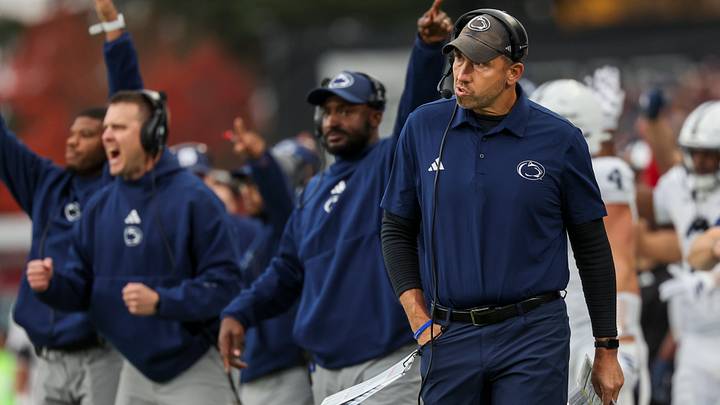
It’s official. On Monday, Heather Dinich of ESPN reported that ESPN reached a five-year, $1.7 billion deal with the CFP that will expand the field to 24 teams starting in 2027. The move coincided with announcements from each of the Power 4 conferences that they’re eliminating conference championship games. What we all expected has finally come to pass, and the Big Ten, which was the strongest proponent of expansion to 24 teams over a 16-team field, largely got its way.
Penn State needs to and should be expected to do more than just make a 24-team field.
One of the biggest reactions to this move will be to say that it’s good for head coaches at schools with real expectations because they will now have a much easier path to the CFP. But in reality, it will only take a few years for a CFP appearance to not be enough at most of those programs anyway. At Penn State, it already wasn’t enough.
James Franklin was fired one year after finally breaking through and reaching the then-expanded 12-team CFP. He even won his first two games, thanks in large part to favorable matchups based on a flawed seeding format, and made the semifinal, but even that wasn’t enough.
Whether it’s a justifiable expectation based on the program’s investment level and financial resources or not, Penn State expects not just to compete for, but to win a national championship. Franklin didn’t. That’s why Campbell has his job.
While that expectation probably should fade away until Penn State finds the financial backing to start spending like a serious contender and not field the seventh-most expensive roster in the Big Ten, it will remain the expectation of most of the fanbase and important members of the administration.
In that case, even after this year’s disastrous start to Campbell’s tenure, it won’t be viewed as some significant accomplishment if Campbell sneaks into the CFP field as the No. 23 seed in 2027. It just won’t.



The expanded access of the 24-team CFP is to keep mid-tier programs invested
While there are a ton of programs that are main beneficiaries of the increased access that the 24-team field represents, Penn State really isn’t one of them. This is a program that would have made a 24-team CFP field seven times over Franklin’s 12-year tenure. Getting in isn’t an accomplishment; it’s the bare minimum.
If Campbell makes the next three 24-team CFP’s and doesn’t win a game in the playoff or host a first-round matchup at Beaver Stadium, the fanbase will be, and probably should be, fed up. That’s not to say the administration will be looking for a way out of the ludicrously expensive and lengthy 8-year, $75 million contract, but the temperature of his seat would undoubtedly be rising.
No, the 24-team CFP isn’t exactly for Penn State. The Nittany Lions had a chance to, and did, make the field when it was at 12 teams. It will make them a mainstay, but Penn State was going to continue to invest in football even if it missed the 12-team field for a few years.
However, of the 60 Power 4 teams with a high-end roster budget estimate of $20 million and the 46 teams reportedly spending at least $20 million, how many are going to continue to pour that much money into football without any realistic shot at reaching a 12-team field? In the NFL, about 44% of the 32 teams make the postseason. In the NBA, that number is over 50%. With 69 Power 4 teams, if you include Notre Dame, 12 spots is just 17%, and 24 is still only 34%.
If the CFP stayed at 12, there’s a very realistic chance that in a few years, as Ohio State, Texas, LSU, and others continue to blow well past a $50 million roster, mid-tier programs would realize their $20 million is being spent in vain and would cut it in half to allocate their resources elsewhere. Boston College is already doing that, spending just $8-13 million on football and investing in Luke Murray and the basketball program instead.
If that were to happen, it would not only lead to further consolidation, which might be inevitable anyways, but it would also meaningfully deteriorate the product on a weekly basis because more lopsided spending means more lopsided results.
This expansion guarantees that Pitt, Wake Forest, which has a really good team and could get left out this year, Houston, Minnesota, Northwestern, and so many others continue to spend like they have a serious chance of making a return on their investment. It’s not for coaches like Campbell at Penn State or Matt Rhule at Nebraska or Alex Golesh at Auburn to pump up their resumes and hold onto their jobs. Because those programs will also invest in football, and fairly or not, will always have national title aspirations. So in just a few years, being just one of 24 won’t be nearly good enough.
 Add us as a preferred source on Google