

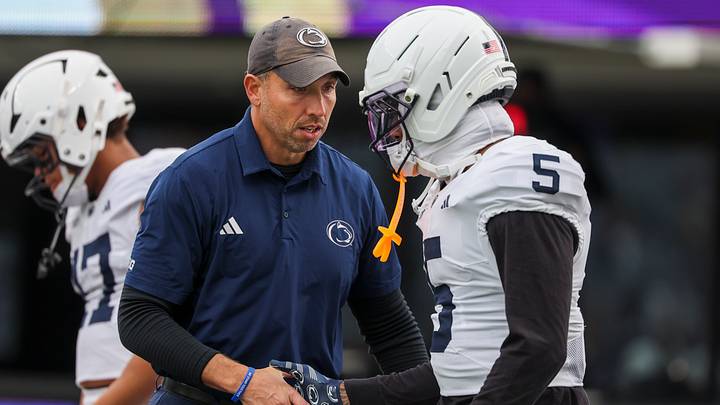
The Nittany Lions went out to Seattle in Week 10, and while it didn’t come without a bit of second-half stress, it brought back another Big Ten win. That’s two in a row for Penn State, which is now 5-4 overall and 2-4 in conference play heading into a two-game homestand against Minnesota and Rutgers, with an 8-4 finish looking increasingly possible or even likely.
The toughest game left will come in Week 11 as Penn State hosts Minnesota at Beaver Stadium on Saturday, and ahead of that matchup, head coach Matt Campbell and defensive coordinator D’Anton Lynn spoke to the media in their weekly press conference on Tuesday.
5. There’s a lot to like about the culture Matt Campbell’s wants
Campbell was asked about the value of players like Cam Wallace, Ibn McDaniels, Ty Blanding, and others stepping into larger roles late in the season to prove to their teammates, essentially, that playing time is earned and their role isn’t set in stone.
Campbell immediately spoke about the lofty goal of establishing a program built on trust and the steady improvement of this group. “To be able to have these young men step up this late in the season and keep getting better. Again, it’s the one thing that I’m proudest of this team so far, we’ll see if we have got the courage and perseverance to keep doing that, but can you keep getting better every week? Can you play your best football at the end of the season?”
Now, the message of steady improvement felt incredibly hollow when this team was losing, so we can’t start drinking the Kool-Aid from a fire hose after two wins over Purdue and a very down Washington team. Still, it’s hard not to see the vision of a developmental program coming together with so many young players excelling in larger roles down the stretch.
It can’t be this staff’s only trick. They have to get elite players into this program, and right now, the talent level is a long way off. But you can understand why Campbell’s message plays in a locker room, and to me, those success stories are the biggest reason for long-term optimism that this will work.
4. This staff is still searching for the right balance to protect a lead
Campbell was asked about his decision to essentially sit on the ball and take it into half with a 28-6 lead, and cited a negative play that put his offense behind the sticks, Washington having three timeouts, and getting the ball to start the second half as reasons he wasn’t more aggressive.
Those were all defensible reasons for a lack of aggression in that spot, but also, with a veteran quarterback Campbell continues to praise for his poise, maybe it would have been worth going for the kill shot. Then, coming out of halftime, seemingly not wanting to play overly conservatively and let the lead slip away as it did against Wisconsin in Week 4, Penn State attempted a pass on 10 of its first 12 plays from scrimmage.
Asked about that decision, Campbell explained that a few of the throws were RPOs, so it was, at times, a read-based decision from Rocco Becht, and correct ones at that. However, he also admitted that he and offensive coordinator Taylor Mouser had conversations on the headset during the game and in the staff meeting on Sunday about abandoning the run game in that spot after it had worked so well in the first half.
The run game was ultimately what protected the lead as the offense salted the final seven-plus minutes away. It almost feels like Campbell and his staff are stuck in the middle, between wanting to protect a lead and not wanting to take their foot off the gas. It could be a reason that Campbell was typically more bankable as an underdog at Iowa State than he was as a favorite.
For what it’s worth, Saturday’s win over Washington was Penn State’s first outright win as an underdog since 2021.
3. Penn State is building depth at the wrong linebacker spot
Linebacker looked to be a position where Penn State was overflowing with talent at the start of the season, but for a few weeks now, there has been a complete lack of depth at the second level. Marcus Neal Jr. has moved from safety to linebacker to help address those issues, and he saw some third-down work against Washington. Cam Smith also played a bit as he gets back from injury. But neither can see a particularly large workload because they’re boxed out by probably the best player on the team: Tony Rojas.



“I think Marcus is only going to continue to grow at WILL linebacker,” Campbell told reporters when asked about his former starting safety. “I’ve sat here and raved about Cam, and the hard thing is Cam is playing behind one of the best players on our team,” Campbell said, referring to Rojas.
Losing Alex Tatsch to injury obviously complicated the development at linebacker this year, and if Neal and Smith’s skill sets are better suited to playing WILL long-term, that’s where it’s best to get them on the field, even in limited action this year. Rojas could easily be off to the NFL this offseason, though he does have one season of eligibility remaining.
But for this team, Penn State needed to develop some depth at MIKE linebacker, where Kooper Ebel and Cael Brezina have been a relative weakness for the defense. Ebel continues to miss tackles, and both, coming over from Iowa State’s 3-3-5, lack the sideline-to-sideline speed necessary to play MIKE in a 4-2-5 system. It would be great to see Smith or Neal, who Campbell and D’Anton Lynn both hinted could be ready to play more on first-and-second down soon, take some of those snaps away from Ebel and Brezina, down the stretch.
2. Are we completely sure Koby Howard is a “future leader” of this football team
After announcing that Koby Howard’s return is on a “pause” and that it could continue to the end of the season, Campbell switched to a big-picture view of the program when talking about Howard’s willingness to help his teammate on the sideline, as he’s missed the last six games with an injury he sustained in Week 3.
“I think it’s really hard to be injured in college football. Right? We’ve got some great players: Max Granville, Alex Tatsch. We’ve got guys that, man, they were coming of age in their careers, and you face a setback again in your career, and Koby’s first. These are the future leaders of our football program. And great players have to stay, but you have to keep growing.”
On the one hand, Campbell is right to be protective of his young star wide receiver and to keep him on the sideline down the stretch if he’s not 100%. Sure, as it seems he was nearing a return, it looks murky to essentially shut him down now, but for Penn State, long-term, it’s probably the right call.
On the other hand, it’s impossible not to wonder whether Howard is looking ahead to the offseason and potentially entering the transfer portal, as Chaz Coleman did last year when he seemingly shut it down after a hot start. Not to accuse Howard of that, but understanding that it’s a part of the game for players in college football where there are very few multi-year guaranteed contracts, and you have to do what you can to protect your value and your leverage, especially when your team is well out of the College Football Playoff race.
Hopefully, that group of injured players is the future core of this team because they all look to have tremendous upside. In the portal era, though, it’s hard to have much certainty about what next year’s roster looks like.
1. The second-half struggles don’t sound like scheme problems
Penn State was outscored 19-0 in the second half of its Week 10 win, and as Campbell made a note of, when asked about the persistent second-half struggles this season, it has been outscored 42-10 in the third quarter.
It’s hard not to see or hear that number and not jump to the conclusion that Penn State either isn’t making the right halftime adjustments or isn’t responding to their opponents' adjustments quickly enough. However, both Campbell and Lynn were asked about it, and neither pointed to anything schematic:
“Leverage and missed tackles again,” Lynn stated as the primary reasons for his unit’s second-half issues against Washington and this season. “I thought we did a really good job of it the first two quarters. You look at the second half, you know, there's five plays, whether it’s run game or pass game, we lose leverage, guys don’t make each other right, and we give up big plays. It’s frustrating, but we have to not get bored doing the same thing over and over again.”
Campbell echoed a similar message about mental fortitude: “It’s a real problem, I’ll be honest with you. And my concern is I think there’s times where it’s a mental maturity piece of it in my opinion.” Which is an alarming thing for a head coach to admit.
Campbell spoke about conditioning, schematics, and his role in elevating everyone’s mental maturity, but both he and Lynn pointed to similar problems, which they can’t solve on the chalkboard.
 Add us as a preferred source on Google