

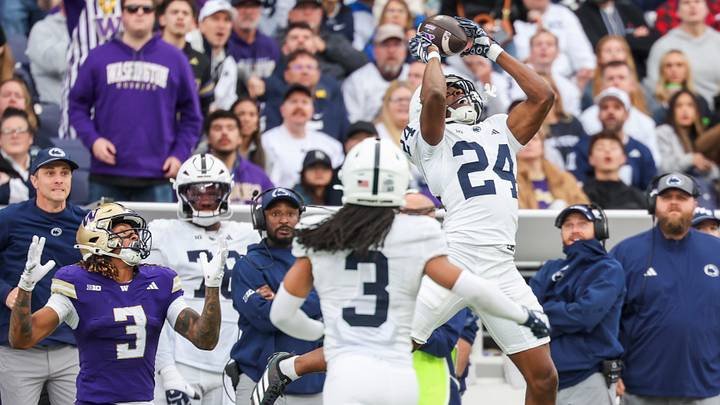
It was a tale of two halves for Penn State in Week 10. Matt Campbell’s Nittany Lions built a 28-6 halftime lead just to give up 19 unanswered in the second half before finally slamming the door shut on a 28-25 win over the Huskies to get to 5-4.
While narrowly avoiding a comprehensive meltdown doesn’t necessarily bring back a ton of good vibes from Seattle, it does open the path to finishing 8-4 with Minnesota, Rutgers, and Maryland left. And there was still more positive to take away from the win than negative, especially for a team that nearly had to wait until November for its first victory over a Power Conference opponent.
Winners:
4. Ibn McDaniels
Much like Cam Wallace, Ibn McDaniels has forced his way onto the field with his performances in practice. At running back, that’s not terribly difficult for this team, but cracking the cornerback rotation is seriously impressive.
Then, in his second game as a rotational DB, the Syracuse transfer had his first interception, temporarily stymying Washington’s second-half onslaught. Having another versatile cover corner is a nice luxury for D’Anton Lynn, and it seems that’s what McDaniels has become. It’s also another developmental feather in Terry Smith’s cap.
3. OC Taylor Mouser
The numbers aren’t especially pretty. Penn State managed a 37% success rate against Washington and stalled out badly in the second half before sealing the game with a 7+ minute drive. However, Mouser deserves props because his offense generated a 13% explosive play rate and averaged 7.12 yards per play. He’s also the architect of the newfound smashmouth run-game identity.
2. WR Chase Sowell
Chase Sowell continues to be a contested-catch monster since his breakout performance against Michigan. His return from injury after missing Week 9 wasn’t quite as voluminous as his 11-catch outing in Ann Arbor, but it was incredibly efficient, producing 125 yards on four catches, and it was visually impressive, making a one-handed grab against tight coverage in the second half.
One of many Iowa State transfers, Sowell has blossomed into a legit WR1 in the Big Ten with ultimate trust from his quarterback, Rocco Becht. That’s especially important as Koby Howard’s injury continues to linger. To the point where he may be done for the season.



1. RB Carson Hansen
It’s not just the production- rushing for 119 yards on 14 carries- or the explosiveness, managing five runs of 10 or more yards in the game, something the entire offense didn’t have one of from Weeks 4-7. It was the patience that was most impressive.
Hansen has always been a downhill, physical, one-cut runner. That style is built for a zone scheme, which Mouser ran at Iowa State last year. But this line is built for a gap scheme with a heavy dose of duo runs, and Hansen has adjusted. He’s learned from press double teams, and makes the defense commit before he does. He looked like a different back in Week 10, the exact back this style of run game needs.
Carson Hansen takes it 12 yards and gets the first TD of the game for @PennStateFball! pic.twitter.com/voHowpwTh2
— FOX College Football (@CFBONFOX) November 7, 2026
Losers:
2. QB Rocco Becht
Becht’s numbers aren’t especially bad, completing 16 of his 27 throws for 240 yards and two touchdowns. But he was sacked three times, had multiple passes batted at the line of scrimmage in the second half, and had just a 33% dropback success rate.
It’s hard to say that if you take away the explosive plays, his day would have been worse. That’s almost always true, and he did make those plays. But if you take away the four explosive plays, he generated -0.38 EPA/dropback. With a reliable run game, a boom-or-bust passing game can work. But you saw the drawbacks of it in the second half.
1. The pass rush
Penn State got its second sack in Big Ten play this week against Washington, but the pass rush was disappointing again. Demond Williams, despite his athleticism, is one of the most sacked QBs in the country. He came in sacked 20 times and on about 20% of his pressured dropbacks. Penn State sacked him once for just eight yards. And if you can’t get the negatives against this Williams, he can be dangerous.
Not taking advantage of Washington’s offensive line, which ranked No. 130 in the country in sacks allowed, is more proof that this pass-rush just doesn’t have any juice. Especially considering Washington has been chasing and in obvious passing situations for basically the entire second half.
 Add us as a preferred source on Google