

Just two Big Ten games have been played, but already so much has changed in the conference. Ohio State got knocked off its perch at No. 1 in the AP Poll with a Week 2 collapse at Texas, Oregon seemingly fell out of national championship contention with its loss to Oklahoma State, and Michigan has slogged to 3-0 and hardly looks like a College Football Playoff team. As a league, the Big Ten is at risk of getting just two teams into the CFP.
Well, how much of those early-season overreactions are true? We’ll probably start to find out with Big Ten play kicking off in Week 4. The same goes for our quarterback evaluations. Are the Big Ten QBs putting up video game numbers against Group of Six competition taking the next step, or will they fall back to earth when their opponents level up?
It’s hard to make definitive claims so early in the year, but with most of non-conference play complete, it’s the perfect time to reset and re-rank the top quarterbacks in the Big Ten.
10. Drake Lindsey, Minnesota
Drake Lindsey was the draftnik darling this offseason with his prototypical NFL size and big arm. He hasn’t quite lived up to that billing so far, but Minnesota may also be a mess this year. No Big Ten QB has had more drops than Lindsey, who is still getting the ball out quickly and accurately and avoiding sacks.
9. Demond Williams, Washington
Washington’s offensive line has been out of sorts to start the season, and with his lack of size, Williams is uniquely susceptible to breakdowns up front. However, his mobility has helped keep the Huskies' offense afloat with a stellar 7.1% pressure-to-sack rate despite facing pressure on 10 more dropbacks (42) than the next closest Big Ten QB (Ryan Browne, Purdue).
8. Katin Houser, Illinois
After two years at East Carolina, former Michigan State QB Katin Houser is back in the Big Ten. He has been hyper-efficient, averaging 9.2 yards per attempt, completing nearly 75% of his throws and ranking top 10 in the country in EPA/dropback at 0.52, sandwiched between Heisman Trophy contenders Darian Mensah and CJ Carr.
Houser is thriving in the quick game and carving defenses off play-action, but when pressured, his 4.3 yards per attempt ranks No. 16 in the conference.
7. Anthony Colandrea, Nebraska
Colandrea has been even more efficient than Houser, ranking No. 8 in EPA/dropback, and Houser’s biggest weakness is the Nebraska QB’s biggest strength. Colandrea loves to make plays out of structure. So far this year, he’s averaging over 10 yards per attempt under pressure.
Colandrea’s biggest flaw throughout his career has been turnovers, but he has eight touchdowns to one interception, and on dropbacks over 2.5 seconds, when in the past he’s been mistake-prone, he has zero turnover-worthy plays, according to PFF.
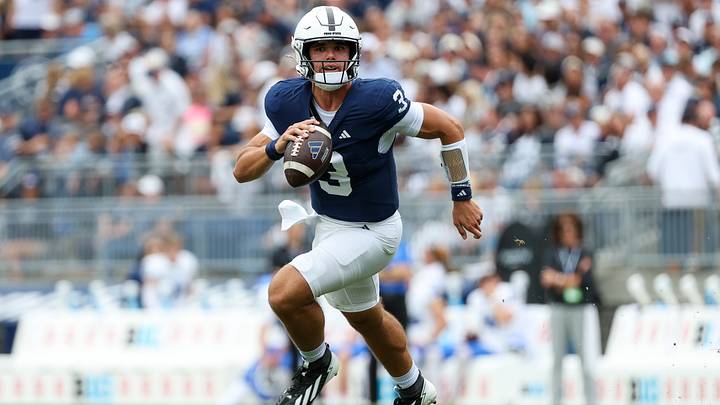
6. Rocco Becht, Penn State
Rocco Becht is the most experienced quarterback in the country, and that shows up with his ability to protect the football and throw with elite anticipation, which is a difficult combination. That anticipation, particularly between the numbers, has allowed Penn State’s passing game to be an explosive play ATM, but the offense has struggled in the red zone, ranking No. 112 in touchdown rate and No. 69 in red zone passing success rate.
When the windows get tighter in the red zone and an offense needs its quarterback to be at his best, Becht is at his worst. Maybe getting his legs more involved will alleviate those problems, but Iowa State’s red zone offense was middling in each of the last three years with Becht starting.
5. Julian Sayin, Ohio State
Julian Sayin finished fourth in Heisman Trophy voting last season, but without Carnell Tate opposite Jeremiah Smith, the Ohio State passing game stagnated against Texas, and Sayin hasn’t been nearly as efficient. He still struggles under pressure this year, with an untenably high 4.28-second average time to throw on pressured dropbacks and a 20.8 pressure-to-sack rate, which is fourth-worst in the conference.
Strangely, this year Sayin has been great at creating outside of structure, which was probably his biggest issue a year ago, but his accuracy and effectiveness in the quick game have fallen off so drastically that his numbers are worse overall. It’s a small sample that includes a loss to one of the best teams in the country, but it’s hard to say Sayin is a next-level difference-maker at the position.
4. Dante Moore, Oregon
Dante Moore has not been Oregon’s biggest problem this season, or even its biggest problem on offense. He just hasn’t been good enough to cover up the issues that have cropped up amid a transition from Will Stein, one of the best play-callers in the country, to Drew Mehringer, his replacement.
Moore ranks No. 84 in EPA/dropback, and if you strip out explosive plays, Oregon’s passing game ranks No. 125 in the FBS in EPA/dropback. Most troubling is Moore’s 3.9 yards per attempt when pressured and 30% pressure-to-sack rate. He’s too talented for these struggles to persist, but it’s been rough so far.
3. Josh Hoover, Indiana
Like Penn State, Indiana has yet to be tested, but just about everything you would have hoped to see out of Josh Hoover after his move from TCU to Indiana has come to fruition. Hoover, already one of the most prolific RPO quarterbacks in the country prior to joining the most RPO-heavy offense, is averaging 20.3 yards per attempt with play-action and completing 84.2% of his passes despite a 15.2-yard average depth of target.
Hoover has two dominant downfield threats at wide receiver, and so far, he’s maximizing them. And, much to Sonny Dykes’ chagrin, he’s doing so with 10 touchdowns and no interceptions (though he does have one fumble).
2. Malik Washington, Maryland
Malik Washington has faced two FBS opponents this year, UConn and Virginia Tech. In those games, he has thrown for 706 yards and five touchdowns with no interceptions. He’s been lights out for a team that’s not very good and did everything he possibly could to keep the Terrapins in it with the Hokies last Saturday.
Washington was one of the most impressive true freshmen in the country in 2025, and while not all of them have taken a clear step forward (see: Bryce Underwood), he absolutely has. He’s more decisive, more efficient, and when he needs to show off that arm talent and escapability, it’s as impressive as anyone.
Malik Washington ➡️ Na'eem Abdul-Rahim Gladding
— Maryland Football (@TerpsFootball) September 20, 2026
📺 @FS1 pic.twitter.com/ExbH1C5Oe1
1. Jayden Maiava, USC
It’s a Lincoln Riley offense, so you can pretty much guarantee that the quarterback is going to be effective, but Maiava is starting to knock on the door of Riley’s Heisman Trophy winners. He’s not quite as physically talented, but he’s accurate, sees the field well, and throws with excellent touch, layering the ball to all levels. His arm won’t wow you, but he’s as advanced a passer as you’ll see in college football.
Maiava is No. 5 in EPA/dropback and No. 3 in passing success rate despite playing with one of the youngest group of skill players in the country.
 Add us as a preferred source on Google