

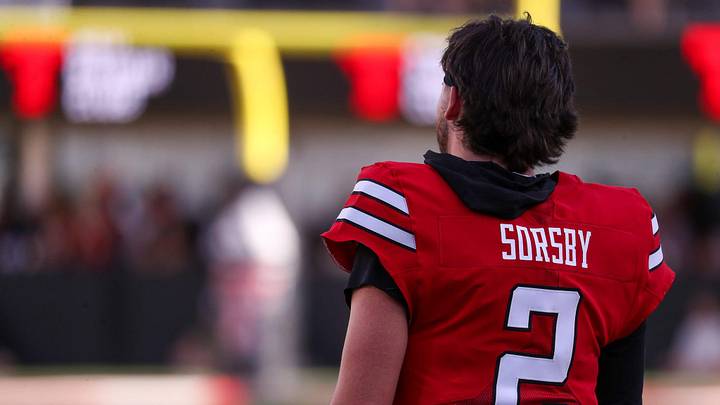
On Monday, a judge in Lubbock, Texas, granted Texas Tech quarterback Brendan Sorsby a temporary injunction against the NCAA, which will allow him to play in the 2026 season after checking himself into an inpatient rehab center for an admitted gambling addiction. While at Cincinnati and Indiana, Sorsby placed thousands of bets on sports, including 40 on his own team.
Monday’s ruling overturned the NCAA’s decision to rule him permanently ineligible. Though he’ll be suspended for the first two games, conveniently against Abilene Christian and Oregon State, he will be eligible to play this fall.
There has been a wide range of mostly negative responses throughout college football, including informal efforts from rival programs and conferences to boycott scheduling the Red Raiders, not just in football, but in all sports. Texas Tech athletic director Kirby Hocutt issued a lengthy statement, admitting that “there’s no perfect answer” and that “We are open to ongoing conversations about how to best handle these issues as an industry going forward.”
There has been a perfect answer to athletes gambling on their team’s games for all of sports history: a lifetime ban. Hocutt’s response was at least somewhat measured. Unsurprisingly, his school’s biggest booster, Texas oil tycoon Cody Campbell, wasn’t so tactful.
“I mean, nobody boycotted to play Penn State a few years ago when that horrible situation happened there,” Campbell told Trey Wallace of Outkick.
Cody Campbell calls out those threatening to boycott playing Texas Tech because of integrity
— Trey Wallace (@TreyWallace) June 10, 2026
He said teams have players with DUIs, woman abusers
“I mean, nobody boycotted to play Penn State a few years ago when that horrible situation happened there” https://t.co/5gNpMI6kwf
Cody Campbell used Penn State’s darkest days to prop up his Texas Tech defense
Campbell’s characterization of everything that happened at Penn State with Jerry Sandusky is correct. It was a horrible, abominable situation with an astronomically worse impact on human lives than a college kid betting on his own team. That’s why many still argue that Penn State’s punishment with a four-year postseason ban, $60 million worth of fines and sanctions, a 20-scholarship cap, and five years’ probation wasn’t enough.
There’s no comparison between the severity of the two situations, which is why Campbell used “that horrible situation” as his comparison point. However, to dismantle Campbell’s argument, there’s no need to compare offenses at all. There is no throughline between the situations because, for one, Penn State did face a punishment, which, pending a possible appeal, Sorsby essentially will not, and as horrible as the offenses were, once the punishment was levied and those involved were removed from their positions, there was no potential impact on the outcome of results.
That’s not to defend the atrocities committed by Jerry Sandusky and covered up by the Penn State program. It’s simply to say that the situations have no relevance, so for Campbell to flippantly evoke such awful acts isn’t simply tone deaf; it’s unfair to the victims to have their darkest moment weaponized so many years later.
Decision makers within college sports aren’t mulling a boycott of Texas Tech because Sorsby placing bets on his own team prior to his arrival in Lubbock is the worst thing that’s ever happened in college sports. They’re mulling it because allowing a player who bet on their own team, at any point in their career, undercuts the integrity of the results on the field and threatens to undermine the viability of the sport long-term.
If the precedent for a player gambling on their own team is a two-game suspension, there is virtually no reason not to begin fixing games intentionally to maximize gambling profits for everyone involved in the sport. It’s a slippery slope, sure, but it’s also a remarkably simple conclusion to draw, and the only logical endpoint.
As one Big 12 coach told Dan Wetzel of ESPN on Monday, "If this is the precedent, then I owe it to my players to bring in people from Las Vegas to teach us how to gamble.”
In some ways, you can make a case, as Hocutt attempted to, that it’s unfortunate Texas Tech would bear the brunt of the punishment for violations committed elsewhere. But it’s not Texas Tech that the NCAA was after; it was Sorsby’s punishment.
Campbell, a billionaire, should recognize as well as anyone that he didn’t do his homework and made a bad investment. He and Texas Tech have benefited as much as anyone from the unchecked capitalistic system of college football in the NIL era, and now, straight out of the billionaire playbook, he’s relying on a friendly judge to correct his mistake and dragging whoever he needs through the mud to feel like the victim.
This, conveniently for the man who led the push for the SCORE Act, the archaic and highly restrictive piece of failed legislation that he hoped would "save college sports." A lot is threatening to bring down college sports, but you can argue that there is no more grave and imminent danger to college football's future than the very player and program he'll fight tooth and nail to defend.
 Add us as a preferred source on Google