

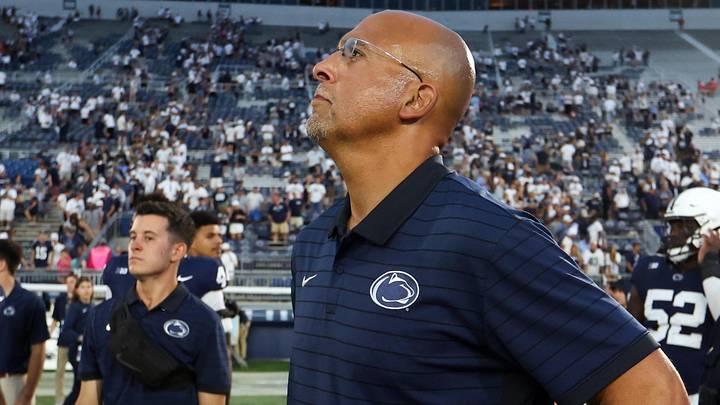
For the past few years, college football has been filled with alarmists, and oftentimes it tends to be the coaches warning about the dark path the sport they so love is going down. As facetious as that may sound, in many cases, they’re justified. In Steve Sarkisian’s case, the Texas head coach just got it wrong.
At the SEC spring meetings in Destin, Florida, on Tuesday, Sarkisian, as every person in college football is seemingly obligated to do, was speaking on the state of the College Football Playoff and sounded the alarm on coaches' job security by invoking James Franklin’s rapid demise at Penn State.
“I watched a coach get fired five games into a season last year after being in the semifinals the year before. That's concerning to me about the health of our sport,” Sarkisian said.
Steve Sarkisian on CFP: "I watched a coach get fired five games into a season last year after being in the semifinals the year before. That's concerning to me about the health of our sport."https://t.co/AcwbGCdJVh
— Pete Nakos (@PeteNakos) May 26, 2026
The only problem is that his message rips away a huge amount of important context unique to Franklin’s situation, and completely ignores his encore performance to that CFP semifinal run.
James Franklin’s firing was about much more than Steve Sarkisian wanted it to be
It fits Sark’s narrative nicely to say that the zero-sum nature of the new College Football Playoff structure is making things unsustainable for the sport as a whole because firing a coach like Franklin doesn’t only impact the coach himself but the entire athletic department, university, and donor base that is tasked with paying his buyout. Ignoring that ultimately Franklin had offset language and a duty to mitigate in his contract that allowed Penn State to settle with him for much less than the $51 million it appeared he was originally owed, Sark’s logic is still flawed.
Franklin was fighting against the “big game James” narrative that even two CFP wins didn’t shake because of how the bracket was structured in Year 1 of the 12-team CFP’s inception. With the four-highest-ranked conference champions earning the top-four seeds and first-round byes, Penn State lucked into a path with SMU in Happy Valley for the first round and Boise State in the Fiesta Bowl in the CFP quarterfinals. Then, when Franklin finally faced a real contender again in the semifinals, once again his team wilted in the biggest moment.
You could actually argue that despite getting the first two CFP wins in program history, Penn State wasn't any closer to actually winning a championship, and whether it's the BCS era, a four-team CFP, a 12-team, or a 24, winning a championship is the goal for Penn State football.
At the time, Penn State was ripped for its soft path to the semifinals, so now to throw the semifinal appearance back in the program’s face is more than a bit unfair. Then there’s everything that followed the CFP semifinal trip, which many fans were already dubious about.
Franklin finally got full institutional alignment and financial backing to make whatever moves he wanted. Those moves included letting Tom Allen walk to Clemson and hiring Jim Knowles away from Ohio State as the highest-paid defensive coordinator in the country as his replacement, and the most significant Transfer Portal activity of Franklin’s tenure with a wide receiver overhaul, swapping out Harrison Wallace III and Omari Evans for Devonte Ross, Kyron Hudson, and Trebor Peña.
Not only did Penn State lose its next big game, falling to Oregon in overtime at the Week 5 Whiteout in Happy Valley, but Franklin also dropped the next two games to UCLA and Northwestern as 20+point favorites.
Knowles didn’t elevate the defense, Andy Kotelnicki’s offense got stale, Drew Allar never took a step forward before suffering a season-ending injury against Northwestern, and the new wide receiver room proved not to be an upgrade. After entering the year as the No. 2 team in the country, Penn State’s national championship hopes, and effectively its season, were over by Week 7.
That’s why James Franklin was fired. Not some symptom of the new CFP structure. In fact, the new CFP structure was the best argument for Franklin to keep his job. If you’re a Penn State fan, you already knew that. But Sark seemingly didn’t, or didn’t want to, because that context wouldn’t have fit his push for CFP expansion.
 Add us as a preferred source on Google