

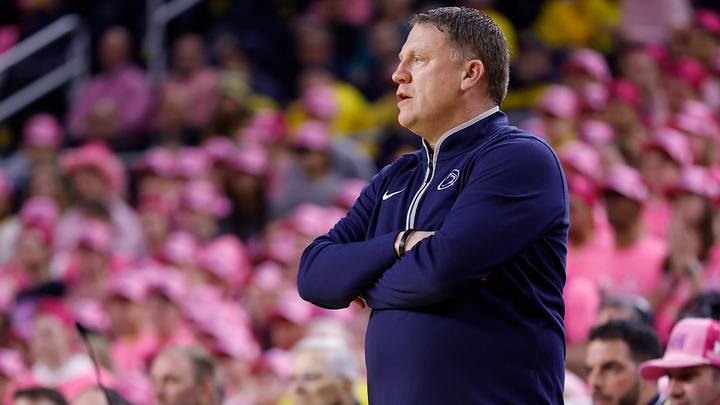
According to CBS Sports’ reporting, led by Matt Norlander and Isaac Trotter, there isn’t a Power Conference team in men’s college basketball this year that is spending fewer than $5 million on its roster. Judging from Mike Rhoades comments this offseason about the university’s lack of investment in his program, it seemed as though the Nittany Lions may not clear that $5 million bar.
However, Penn State isn’t just above the lowest threshold; it’s not even in the lowest tier of men’s college basketball spending, defined by CBS’s thorough reporting as $5-7 million. Instead, Penn State fell in the next tier up, spending $7.1-9.9 million on a roster filled with veteran transfers and European talent for the 2026-27 season.
Washington is the lone Big Ten program falling under $7 million this year, while Northwestern, Purdue, Rutgers, and Iowa all joined Penn State in the threshold defined as “Tier 6” of roster spending in Power Conference college basketball.
Penn State is helping pull the Big Ten down in roster spending
The Big Ten has two teams above $20 million this year: Illinois and Michigan. However, with an average roster spend of $12.7 million, the Big Ten is below the Big East, which has benefited greatly from being the only Power Conference in basketball that does not have a football program to dedicate its revenue-sharing money to.
The average Big East roster costs $13.6 million, inflated by St. John’s and UConn. The average SEC roster this year costs $17.3 million, with four programs: Kentucky, Texas, Tennessee, and Florida, the preseason No. 1 team, spending over $20 million.
There is a significant gap between the Big Ten and SEC. Part of that is due to a few Big Ten programs that invest somewhat seriously in men’s hockey and wrestling, but on aggregate that’s probably offset by the SEC’s spending on baseball and softball.
It’s staggering to see the discrepancy between the college athletics’ two mega conferences on the hardwood, and programs like Penn State are significantly pulling down that average.
Purdue is the outlier in Penn State’s tier, though the Boilermakers are expected to take a step back after losing a historic senior class that included Braden Smith, Fletcher Loyer, and Trey Kaufman-Renn, who somehow wound up at Kansas after becoming the No. 59 overall pick of the Minnesota Timberwolves in the 2026 NBA Draft.
Penn State is probably wise not to spend much on its basketball program. It’s a football school, and athletic director Pat Kraft understands that. The outside investment from donors wouldn’t be there to support a costly men’s basketball program, so it would come down to spending major revenue-sharing dollars, which need to be directed to Matt Campbell so he can attempt to lead Penn State back to the top of the Big Ten.
However, it is a bit shocking just how many Big Ten teams inhabit the lower reaches of college basketball spending, with the Nittany Lions, schools like Iowa, which just reached the Elite Eight in Ben McCollum’s first year leading that program.
If this big of a gap persists between the two conferences, then the SEC will pull away as college basketball’s dominant conference, as it appears to be doing in football this year, despite the Big Ten producing the last three national champions.
The Big 12 and the ACC check in just behind the Big Ten, averaging $12.6 million and $11.9 million, respectively.
Should Penn State spend even less on basketball?
It's worth considering if Penn State not being in the bottom rung of roster spending is actually a mistake for the athletic department. As good as it would be for the program to be successful, it has never been, and spending somewhere near $8 million on the roster won't allow the program to keep up with the likes of Illinois and Michigan or, likely, even sniff a spot in the expanded NCAA Tournament.
So, should Penn State bottom out even further? It's tough to do that to your head coach, but Rhoades has already opened up about how greatly the deck is stacked against him. If you asked most Penn State fans, they'd probably say that they'd rather have the athletic department direct the $2 million or so dollars spent on Rhoades' roster to hang it one rung above Washington would be better spent on the football field.
Though the return on investment for the nearly $30 million Penn State spend on Campbell's program this year might be a trip to the Duke's Mayo Bowl, at best.
 Add us as a preferred source on Google