

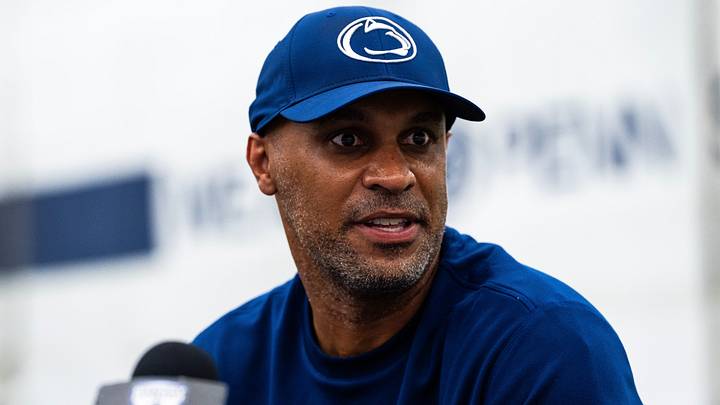
Penn State has never had a tough time finding good linebackers, but Matt Campbell brought a bunch of them with him from Iowa State anyway. Kooper Ebel, Caleb Bacon, and Cael Brezina all followed their head coach to Happy Valley, and after leaving the 3-3-5 defense behind with longtime defensive coordinator Jon Heacock’s retirement, Campbell has about six starting-caliber off-ball linebackers and only two spots for them to play.
That’s a good problem to have, but still one defensive coordinator D’Anton Lynn has to solve in the short-term. Then, with only one of the six exhausting his eligibility after this season, it becomes Campbell and general manager Derek Hoodjer’s situation to sort out.
Can Penn State possibly keep all of its linebackers happy?
When you build depth in modern college football, you usually don’t get to keep it for very long. If a player who is good enough to start somewhere else is glued to the bench on your roster, they’ll almost always hit the eject button and hop into the transfer portal in search of a payday and playing time. And who could blame them?
That will be the risk with this linebacker room after the season, with Tony Rojas and Ebel, the projected starters in Lynn’s 4-2-5 scheme, both with one year of eligibility remaining beyond 2026. Rising sophomore Alex Tatsch is returning from injury, Cael Brezina and Cam Smith are pushing for playing time, and Bacon is a former All-Big 12 honorable mention who has been forced to work at defensive end in fall camp just to find playing time.
Lynn’s challenge is to find a way for all his talented linebackers to get snaps at a position that doesn’t lend itself to rotation, especially now with in-helmet communication. Either Ebel or Rojas will wear the green dot, which means they essentially can’t come off the field, and you wouldn’t necessarily want the other player to work with a different partner series after series. Plus, they’re both really good players.
Campbell’s challenge is to keep all his talented players at one position on the roster beyond this year. Interestingly, Lynn can probably solve both. If he’s creative enough to keep Rojas, Ebel, Tatsch, Brezina, and Smith all happy with their playing time, it’ll make it much easier for Campbell and Hoodjer to convince them to stay.
Is it better to play your best 11 or play to the best matchup?
Maybe the answer is to break out a bit of 3-3-5 this season, with a SAM linebacker and walking down to the line of scrimmage to set a hard edge or get after the passer. The only problem is that player would likely be Bacon, who can also work into the edge rotation as a defensive end, but who's out of eligibility after this season anyway. That’s a handy solution for Lynn, but it doesn’t help in the offseason.
The other option is to match the rising rate of heavy offensive personnel with more mass in the second level, but that’s risky. The past two seasons, 12-personnel usage (2 tight ends, 1 running back) is up nearly 10 percent from where it was a decade earlier.
Adding a linebacker to match those looks makes it easier to stop the run, but also leaves a defense susceptible to big passing plays over the top, which is what most play-callers are actually hunting when they put an additional tight end on the field.
Playing a 4-3, as Indiana did last season, even in 11-personnel looks, is playing into the offense’s hands. But if it puts Penn State’s best 11 players on the field, that may still be the right decision. And if Lynn can make it work, he can make Campbell and Hoodjer’s offseason much less stressful.
The best-case scenario
There's another scenario, however, that could take the pressure off, and it's probably the best case for Penn State. Rojas and Ebel do start and play the overwhelming majority of the snaps because they're too good to take off the field. They're so good, in fact, that they project as Day 2 picks in the 2027 NFL Draft and leave with Bacon to give way to Tatsch, Brezina, and Smith as the starters next season.
 Add us as a preferred source on Google