

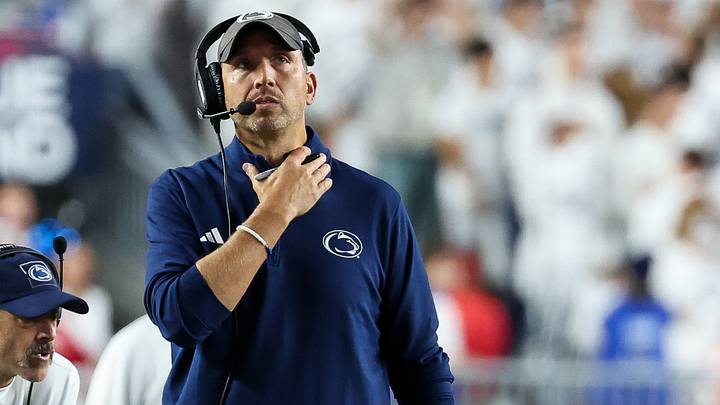
After starting at No. 18 in the preseason AP Poll, Penn State climbed as high as No. 13 amid its 3-0 start with wins over Marshall, Temple, and Buffalo. Then, the Nittany Lions quickly tumbled out of the top 25 with a 24-20 Week 4 loss to Wisconsin and have little chance of working their way back in after dropping the next two games to Northwestern and USC as well.
Now, halfway through the season and heading to Ann Arbor for a Week 7 showdown with a similarly struggling Michigan team, Matt Campbell is in danger of starting his Penn State tenure 0-4 in conference play.
Even compared to last season’s 7-6 disappointment that cost James Franklin his job six games in, Penn State’s 2026 season has been disastrous.
It began with athletic director Pat Kraft hiring Campbell too late in the process to assemble a real recruiting class, continued with a transfer portal class that prioritized culture and familiarity over high-level talent, and has seemingly culminated in a lost season in Happy Valley.
Halfway through the year, it’s hard to give the team overall any grade other than an F, but let’s break down the mid-term report card a bit further.
Campbell doesn’t get an F because he didn’t trip up against Penn State’s ridiculously light non-conference schedule. But since then, he’s been a mess. You can dock him for choosing Rocco Becht over attempting to keep Ethan Grunkemeyer or for entrusting Kooper Ebel at the heart of his defense, but even setting personnel decisions aside, his game management has been about as bad as it could be.
Campbell managed to waste three interceptions against Wisconsin, including a pick-six, choosing to sit on the lead in the second half as the Badgers chipped away. Then, against USC, he spent five timeouts in the game, and not a single one was used for a late-half situation. Lincoln Riley tricked him into burning his final timeout late, and if you’re getting punked by Riley in 2026, seven years removed from Riley’s last College Football Playoff trip, you’re in a bad spot.
One of the original sins of the Campbell and general manager Derek Hoodjer’s roster construction was entrusting the offense to Becht and assuming he could successfully make the jump from the Big 12 to the Big Ten. Becht isn’t the biggest problem with the offense, but he’s far from a solution to the problems ailing its offensive line and pass-catching group.
Even against USC, by far his best game against Big Ten competition, Becht left a lot of meat on the bone with missed reads and inaccurate throws as the offense managed six points in the second half.
Overall, his numbers look solid, but they’re buoyed by dominant performances with a healthy Koby Howard, by far the offense’s best player, and against Group of Six competition.
Penn State ranks No. 104 in EPA/rush and rushing success rate this year. You can quibble about the distribution in a crowded backfield between Carson Hansen, James Peoples, and Quinton Martin, but none of the three have been consistently effective against Big Ten competition.
Peoples is the best of the bunch, if for no other reason than his overall competence in the passing game, both as a pass-catcher and a pass-protector, but as a runner, he’s shown why Ohio State was so eager to move on from him early last season.
The right side of Penn State’s offensive line has been legitimately good. Anthony Donkoh was the only returning starter, and he’s played like it through six games, and Cooper Cousins has lived up to his pedigree as a former top-100 recruit. However, the offensive line is a weak link unit, and Penn State has quite a few weak links.
The issues start at left guard and center, where Trevor Buhr and Brock Riker have been disastrous, Buhr unable to handle the speed of Big Ten interior defensive linemen and Riker unable to handle their power. At left tackle, Malachi Goodman has shown promising signs, but isn’t a finished product by any means.
For as bad as the running backs have been, it’s hard to discern whether they or the group blocking for them is more to blame for the struggles on the ground.
Koby Howard lived up to every bit of hype in the first three games of the season. Then he got hurt. Chase Sowell is a nice piece of a wide receiver room, not a No. 1, and Brett Eskildsen doesn’t belong in the Big Ten. Even in a tight end-heavy system under offensive coordinator Taylor Mouser, Penn State isn’t close to having enough good wide receivers.
In some ways, this group gets a TBD grade because everyone may look much better slotting into their roles when Howard returns from injury, and the fact that Howard is in this room at all boosts the grade, but there isn’t much to get excited about outside of No. 6.
Tight end has been a strength for the Penn State program for years, and that’s still the case even if there isn’t a Tyler Warren-caliber player in this group. Benjamin Brahmer is a nice red zone pass-catching weapon, Gabe Burkle is an elite blocker, and Andrew Rappleyea is a solid all-around piece. However, Rappleyea has had more struggles as a blocker than anybody would have hoped for such an integral piece of the offense.
Without a real difference-maker, this group can’t get higher than a B, but it’s indisputably the best thing about the offense.
Penn State ranks No. 105 in sacks per game, and its two leaders in pressures, Yvan Kemajou and Ikenna Ezeogu, racked up 18 of their combined 27 pressures in non-conference play. With Max Granville out for the year, there isn’t a speed-rushing element along the defensive line at all. Off-ball linebacker Tony Rojas is the only player on the team with multiple sacks (4).
Then, on the interior, a unit built to eat blocks and plug up the run game with 300+ pounders ranks No. 72 in the country in run stuff rate and No. 71 in non-explosive EPA/rush, a pretty clear measure of down-to-down effectiveness.
If Tony Rojas isn’t the best player on Penn State’s defense, leading the team with 43 tackles, 4 sacks, two interceptions, and a forced fumble, he’s no worse than No. 2. Even with poor play from Ebel next to him, Rojas has put together the best year of his Penn State career, coming off a season-ending injury in 2025. The rest of the group, however, has left a lot to be desired.
The safety play at Penn State has been bad. Marcus Neal Jr. has been benched, Jeremiah Cooper needs to be, and Zion Tracy had to be moved from nickel to safety just to stop the bleeding.
However, Penn State’s corner play has been excellent. Daryus Dixson and Jahmir Joseph are both promising second-year players, and Audavion Collins has had the type of late-career breakout that could thrust him into the first round of the 2027 NFL Draft.
Collins has been targeted 12 times and allowed two catches for seven yards, with five pass breakups. To say he’s the best cornerback in college football is a stretch because Leonard Moore at Notre Dame still exists, but he is on a short list behind him.
Collins is No. 1 in the country by snaps per reception at 63.5, which is 15.5 snaps per reception more than No. 2 (Andrew Marshall from Nebraska) and 31.7 snaps per reception more than Mississippi State’s Kelley Jones led the country with in 2025. That’s probably not sustainable, but it’s an unfathomably good start.
 Add us as a preferred source on Google