

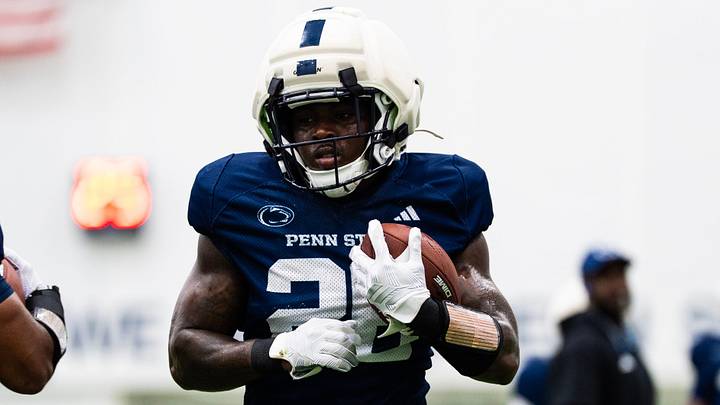
You would think that after graduating the program’s No. 1 and No. 4 all-time leading rusher, Penn State would be hurting for depth in the backfield, but the opposite has seemingly been the case through fall camp. As crazy as it may seem for first-year head coach Matt Campbell to consider splitting carries four ways, it’s the right approach in the long run.
Matt Campbell brought Carson Hansen with him from Iowa State after a 952-yard, six-touchdown season in 2025, added James Peoples from Ohio State, and retained Quinton Martin Jr., a former four-star who impressed in the Pinstripe Bowl win over Clemson in December.
At that point, Cam Wallace, a redshirt junior who has stuck it out in Happy Valley despite getting just 24 career carries and suffering broken bones in both legs at the start of the 2024 season, which cost him that entire year, was a complete afterthought. He entered the transfer portal before returning, and now it seems that may have been the right call.
“Cam Wallace has had a great camp,” Campbell said in his fall camp press conference on Thursday. “Really had a great day in the scrimmage on Saturday. Got 1s reps, 2s reps, 3s reps.”
Cam Wallace got first-team reps in Penn State’s fall camp scrimmage
Wallace, out of Mount Vernon, Georgia, has always had great burst at the position. He’s gotten work as a returner because of it and will probably factor into the special teams plan for Penn State again this year. He didn’t, however, play a single snap in Big Ten play last season as Nicholas Singleton and Kaytron Allen handled every carry after the non-conference games wrapped up in Week 3.
This year, it’ll be more than just a two-back system, and if Wallace is taking first-team reps in a fall camp scrimmage, there’s a good chance he won’t be relegated to mop-up duty in blowouts. And while a four-man rotation at running back is unique, it’s not a bad idea for a team that has a chance to make a deep run in Campbell’s first year, despite the overall roster talent seemingly taking a step back this offseason.
A deep rotation will help Penn State take advantage of its soft schedule
There are multiple advantages to having an easy schedule, both in the Big Ten, where Penn State plays five of the seven teams with the longest odds to win the conference and lucked into avoiding Indiana, Ohio State, and Oregon, and in the non-conference when the Nittany Lions scheduled Marshall, Temple, and Buffalo.
The first is obvious; you can rack up an impressive win total playing inferior opponents. The second is a bit more nuanced and is the SEC’s only remaining ammunition in the argument over which conference is the best in college football right now: attrition.
“We hope we’re playing for the long haul,” Campbell said. “And the reality is, at that position, you’re going to need a lot of them.”
Playing better opponents each week, even if you’re able to win, wears a team down, especially in a one-bye-week season, as this year is. You can pull your starters in more fourth quarters, you can go deeper into your rotations, and if you’re better than a team, typically you’re going to have the physical advantage. That not only keeps your team fresh, but it minimizes the risk of injury with a lower snap count.
Then, when you do play the better teams on your schedule, or make it to the College Football Playoff, you’re fresher and healthier. On this run of three straight national championships won by Big Ten teams, Indiana, Ohio State, and Michigan played a total of zero Power Conference opponents in the non-conference. Still, none had as favorable a Big Ten schedule as Penn State does this year.
So, Campbell should give Hansen and Peoples, presumably the two best backs on the roster, though that is subject to change, a lighter workload early in the season and against less Big Ten competition. He should go deep into his defensive line rotation in those same games and play all five of his linebackers when there’s an opportunity to do so.
Because when Penn State does play Michigan, Washington, and USC, the most talented teams on its schedule, it’s going to need them, not just healthy, but with a little extra hop in their step that those teams may not have.
When you don’t have a decided talent advantage- which Penn State will not have against those three teams, and certainly would not against ‘the big three’ of the Big Ten- you need every possible edge you can get. The soft schedule is an advantage for Penn State, and Campbell has to milk it for everything it's worth.
 Add us as a preferred source on Google