

The Federal Aviation Administration issued a nationwide ground stop on Friday afternoon, which forced the Minnesota football team to make the two-hour flight from Minneapolis to State College on Saturday morning, arriving just seven hours before the 7:00 p.m. ET kickoff at Beaver Stadium.
PJ Fleck’s Golden Gophers also arrived without three of their key defensive linemen, Theorin Randle, Jaylin Hicks, and Riley Sunram, available. That group combined to play 64 snaps along the defensive line in Week 10 against UCLA, but all were listed as out on the game-day availability report.
The combination of travel and injuries saw Penn State balloon from a 9.5-point favorite to 12.5 before kickoff. Matt Campbell’s team had every reason to turn this battle for the Governor’s Victory Bell into a rout. Frankly, Minnesota looked like a team that had spent its morning airborne, allowing the Nittany Lions to build a 28-0 lead by halftime.
That lead stretched to 35-0 before Minnesota added two scores and Penn State tacked on a garbage-time touchdown pass from backup quarterback Alex Manske in the fourth quarter, the first of his career, for a 42-14 win.
Good teams handle their business, and Penn State might be rounding into one
Sure, the entire deck was stacked in Penn State’s favor. The Nittany Lions had a few injuries, missing defensive end Caleb Bacon and cornerback Jahmir Joseph, and still without star wide receiver Koby Howard, who hasn’t seen the field since Week 3, but nothing as debilitating as Minnesota’s lack of depth along the defensive line.



Those absences forced Minnesota to play its star edge rusher, Anthony Smith, on the interior for much of the game. And still, the Nittany Lions racked up 229 rushing yards against a typically stingy Minnesota defense, behind 126 yards on 12 carries from Carson Hansen, all in the first half.
Hansen left the game with an injury in the final minutes of the half, prior to Rocco Becht’s one-yard touchdown toss to Cam Wallace that made it 28-0. He was the best player on the field before his injury, and without him in the second half, the offense stalled. With all four downs at their disposal and defensive coordinator D’Anton Lynn content to simply rush four in hopes of protecting the lead he helped build with an aggressive, attacking game plan in the first half, Minnesota’s offense found some life after the intermission.
However, rather than letting the lead slip away as the Nittany Lions did a week ago in Seattle, surrendering 19 unanswered second-half points to the Huskies, Penn State got the stop it needed, added a bit of insurance, and closed out a comprehensive 28-point victory to reach bowl eligibility; that’s not nothing.
Penn State should have handled its business exactly as it did. Early in the season, though, there was nothing about this football team that would have indicated that it would. From its second-half collapse against Wisconsin in Week 4 to its letdown loss to Michigan in Week 7, this team couldn’t run the ball and couldn’t pressure the quarterback. On Saturday, Penn State averaged 5.6 yards per carry and sacked Drake Lindsey three times.
Without a difference-maker along the defensive line, this current iteration of Penn State is always going to struggle a bit to put teams away. It’s just not built for that. But the D-line, which gave up over 400 yards on the ground against Northwestern in Week 5, held Minnesota, which, in fairness, has struggled to run the ball all season, to 41 yards on the ground.
Washington was the toughest test on Penn State’s schedule after the bye week. So there’s no good measuring stick for a team that looks like it belongs in the upper half of the Big Ten and may be deserving of the 8-4 record it will likely end the year with, as Rutgers and Maryland are up next.
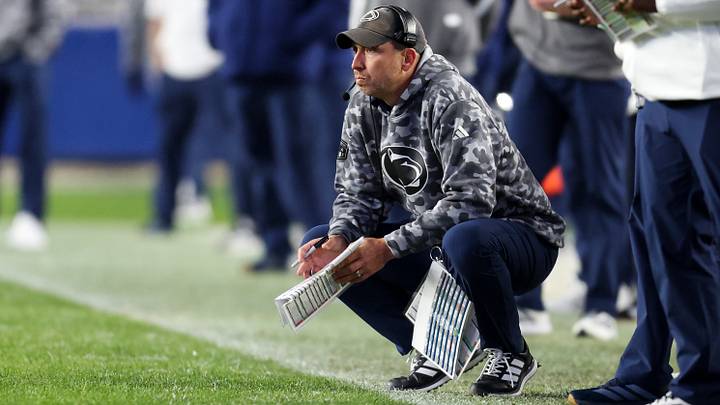
But good teams pound bad teams. That’s what Penn State did on Saturday. It’s a credit to Campbell and his staff for spending the entire year chiselling away at the rough edges, and it’s encouraging for what they can do heading into Year 2.
 Add us as a preferred source on Google