

When a new coaching staff takes over a college football program, the traditional expectation is always patience. Rebuilds historically took multiple recruiting cycles before results showed on the field.
In today’s college football landscape, that timeline is rapidly shrinking.
Penn State is utilizing this new era of college football
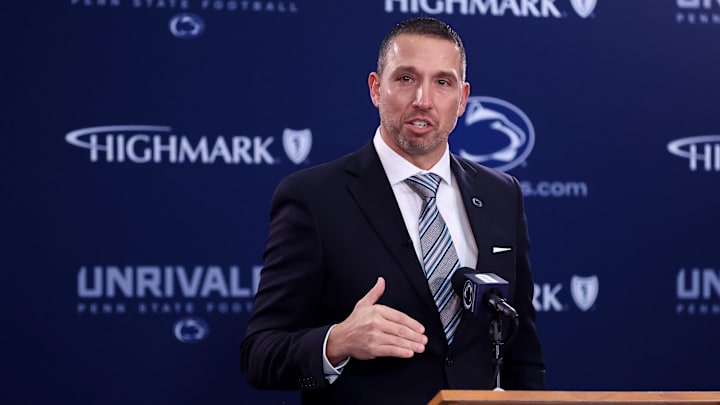
At Penn State, new head coach Matt Campbell embraces a modern approach to roster building. One recent success story in particular he points to is proof that it can work.
During an early team meeting, Campbell referenced the transformation orchestrated by Indiana head coach Curt Cignetti. Cignetti famously reshaped his roster by bringing roughly 40 transfers with him from James Madison.
Nittany Lion center Dominic Rulli recalled Campbell referencing that model.
“You know, he said, ‘Indiana had like 42 transfers last year. Clearly it’s been done,’” Rulli said, according to Penn State Nittany Lions on SI. “He said, ‘That’s the blueprint. We’ve just got to be able to work with it.’ He's not comparing anything with Indiana. He's just saying there's a blueprint that you can build a team in one year with 40-some transfers."
The comparison is a meaningful one, but not because Campbell is attempting to replicate the Hoosiers' situation exactly. Rather, it highlights a new reality in college football.
Programs no longer wait years for recruiting classes to mature before competing at a high level. With the Transfer Portal now a central part of roster construction, a single offseason dramatically reshapes a team’s outlook.
That’s the underlying message Campbell appears is sending his players: rapid turnarounds are possible, and Penn State is not excluded in that conversation.
For the Nittany Lions' case specifically, there’s reason to believe the transition could happen even faster than Indiana’s.
Penn State football has an edge that Indiana didn't
While the concept mirrors what Cignetti did with the Hoosiers, the circumstances are somewhat different.
Cignetti’s transition involved bringing a large portion of his roster from James Madison, a Group of Five program at the time. The move worked largely because those players were already familiar with his system and culture.
Campbell’s situation at Penn State carries a similar dynamic, but with a potentially higher starting point.
After arriving in Happy Valley from Iowa State, Campbell brought a significant number of former Cyclones with him through the portal. That familiarity with his schemes and expectations can accelerate Penn State’s adjustment period in the same fashion it did for Cignetti.
The key difference is that many of those players are coming from a Power Four environment in the Big 12 and now joining a program in the Big Ten.
That experience against high-level competition could make the transition smoother, and potentially position the Nittany Lions to be national title contenders sooner rather than later.
Matt Campbell's leadership will be the ultimate factor
Perhaps the clearest sign of Campbell’s influence is the number of players who quickly followed him to Happy Valley.
In an era where roster movement is common, convincing a large group of players to transfer alongside a new coach still requires a strong level of trust and leadership.
The willingness of so many former Iowa State players to make that move suggests Campbell’s culture already took hold within the program.
That kind of buy-in is critical during a period of rapid roster turnover.
Ultimately, the Indiana example serves less as a direct comparison and more as a reflection of the modern era of college football. The combination of the transfer portal, player mobility, and coaching changes has fundamentally altered how quickly programs can rebuild.
If the players who followed him from Iowa State quickly establish chemistry with the rest of the roster, the Nittany Lions could find themselves competing much sooner than many programs typically do under a new coaching staff.
If Campbell’s blueprint holds true, Penn State may not have to wait long to see the results.
 Add us as a preferred source on Google