

On Monday, ahead of Penn State’s Week 7 trip to Ann Arbor, first-year Michigan head coach Kyle Whittingham was asked about his starting quarterback, Bryce Underwood. The former five-star quarterback hasn’t taken a leap in Year 2, and the Wolverines’ offense has been underwhelming, but Whittingham isn’t wavering on who he wants to have behind center for Week 7, and probably beyond.
Whittingham admitted that backup QB Tommy Carr “got some good reps” on the bye week, but that Underwood is “still our guy.” And he should be. Though he hasn’t lived up to expectations, Underwood is still a 19-year-old sophomore with sky-high potential, elite physical tools, and a major long-term financial investment from the program.
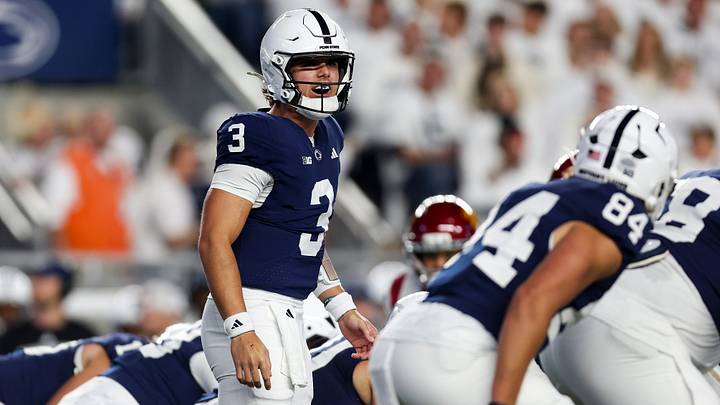
After Penn State’s Week 5 loss to Northwestern, Matt Campbell was similarly asked if he considered making a quarterback change and had a similar stance regarding his fourth-year starter, Rocco Becht.
Becht played his best game of the season against USC, even as the offense managed six second-half points in the 31-23 loss. Campbell has implicit trust in him, and presumably, a pretty long leash. I wouldn’t expect a change, but at some point soon, Campbell should make one, because his reasons for hanging on with Becht aren’t nearly as good as Whittingham’s.
Michigan needs to see if there’s more to Bryce Underwood’s game
The sunk cost fallacy is described as “our tendency to follow through on an endeavor if we have already invested time, money, and effort into it, whether or not the current costs outweigh the benefits” (NIH).
Sticking with Underwood because the previous coaching staff paid him $12 million to flip from LSU when he was the No. 1 quarterback in the 2025 class could be a textbook example. If he’s not the best option, Michigan should be willing to move on. But because of the investment and the reasons the program invested that much in him (other than the desperation of a 2024 season without an answer at QB), the current staff needs to prove beyond a reasonable doubt that he’s not the answer before they move on.
Underwood has not been good for two years, but his potential is gaudy. He may not be the athlete he was billed as coming out of high school in Michigan, but at 6-foot-4, 230 pounds, he has plenty of arm talent, good size, and is more than just a capable runner. If he hits his ceiling, he could be one of the best players in the country.
How likely he is to reach that ceiling is another question, but he’s 19 years old in his second season, and former head coach Sherrone Moore didn’t have a quarterbacks coach on staff to develop him in 2025, so he clearly picked up plenty of bad habits. He still has three more years of eligibility, though they likely wouldn’t all be spent at Michigan if he does stay in college football for that long. So there is incentive for developing him beyond this season, which appears to be a lost year, at least regarding Michigan’s pursuit of a College Football Playoff spot.
None of those reasons apply to Rocco Becht. In fact, planning for the future in a lost season is the biggest reason for Campbell to eventually bench his long-term starter, ideally after Week 7, as Penn State heads into its bye.
Penn State needs an answer on Alex Manske
Becht has not been the only problem with Penn State’s offense, far from it, in fact. He hasn’t been good, but the interior offensive line - left guard Trevor Buhr and center Brock Riker, in particular - has been disastrous. Nobody has separated themselves in the running back room, and without Koby Howard, there has been little to no separation from the pass catchers.
Still, Becht is probably the one on offense who should see the bench in favor of a youth movement first. He doesn’t have some physical potential he’s yet to tap into. He doesn’t have a long-term major investment from the program. And he doesn’t have any eligibility beyond this year.
Regardless of how Becht plays the rest of the way, Penn State is not making the College Football Playoff. It may not make a bowl game. And regardless of how he plays, Campbell and general manager Derek Hoodjer will need to replace him this offseason.
The roster has such a dearth of talent in so many places that an offseason overhaul will not come cheap for a program that isn’t spending like a serious Big Ten contender. Landing an established starting quarterback will cost anywhere from $2 to 4 million, while some QBs are getting paid upwards of $5 million.
Retaining Alex Manske would likely be much cheaper, depending on how well he plays. For example, Ethan Grunkemeyer, after an impressive half-season at Penn State last year, is making $2 million at Virginia Tech this year, and he had the leverage of entering the portal.
But while Penn State may not be able to afford (literally) to pay for a proven starting QB, it also can’t afford (figuratively) to go into next season without a clear answer at the position. Maybe that answer is Manske, but only game reps will determine that, so after the bye week, Manske should get more than just a few.
 Add us as a preferred source on Google