

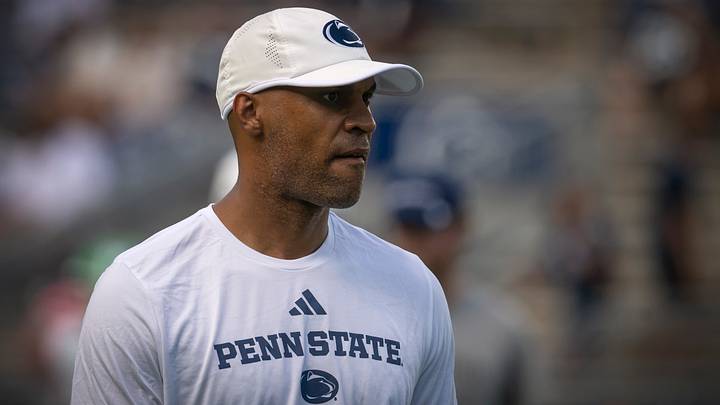
After Matt Campbell’s longtime defensive coordinator Jon Heacock announced his retirement this offseason, Penn State quickly pivoted to one of its own in D’Anton Lynn to run that side of the ball. Lynn left USC and quickly plucked Ikaika Malloe away from UCLA.
Lynn and Malloe worked together under Chip Kelly with the Bruins, so Lynn knew what to expect and what Campbell and general manager Derek Hoodjer needed to deliver: mass.
Ikaika Malloe’s defensive tackles overhaul has failed
Mallow wants big bodies on the interior defensive line, a 180 from Deion Barnes, who prioritized penetration with undersized and quick defensive tackles like Zane Durant. So, Campbell and Hoodjer got him big bodies, bringing in Keanu Williams, Armstrong Nnodim, Siale Taupaki, and Dallas Vakalahi, who are all well over 300 pounds, through the transfer portal.
The theory behind that transformation is that with space eaters who can take on double teams inside, you can stop the run with light boxes and keep your athletic linebackers, Tony Rojas and Kooper Ebel, free to fly around. Then, Lynn, who is one of the most diverse defensive coordinators in terms of his coverage schemes, could use the extra bodies in the secondary to disguise and confuse opposing QBs.
The coverage has been fine; Penn State had three interceptions against Wisconsin. But in the 34-13 Week 5 loss, Northwestern passed just 14 times, completing 10 for 94 yards. Kelly, now the OC in Evanston, didn’t need to drop back his quarterback because his offense ran for 413 yards and four touchdowns on 55 carries, averaging 7.5 per carry with a 58% rushing success rate (96th percentile) and a 12% explosive rush rate.
Malloe’s defensive tackles were consistently blown off the line of scrimmage, and Rojas and Ebel spent most of the night navigating traffic multiple yards downfield before Lynn began to send them on run blitzes far too late.
D’Anton Lynn needs to change his stripes to account for his struggling defensive line
Last year, USC was No. 9 in the country in coverage diversity score according to MatchQuarters. Penn State was No. 4 under Jim Knowles, who has long been known for mixing coverages on the back end, but Lynn was close behind. To be so diverse, you need bodies on the back end and can’t be constantly loading the box to stop the run or sending blitzes to heat up the quarterback, because that simplifies everything behind it.
USC had a much higher blitz rate than Penn State did, particularly run blitzing at the 34th-highest clip in the country. So it wouldn’t be a completely unfamiliar identity for Lynn to slip into, but it’s not the identity this team wanted to have.
Lynn also used the lowest rate of run stunts last year, which tracks with a coach who prefers oversized defensive tackles rather than athletes at the position. But nobody on Penn State’s defensive line is getting penetration right now, not even on the edge.
So if Lynn can’t limit opposing run games on a down-to-down basis, he may need to start selling out for negative plays with slants and twists up front. That carries the risk of giving up more explosive plays, but Penn State is doing that anyways, so why not try something, because there’s no way to correct the personnel mistake in season.
This offseason, Penn State needs to invest in more athleticism and put a premium on penetration in the trenches, but until then, Lynn will have to prove his worth.
 Add us as a preferred source on Google