

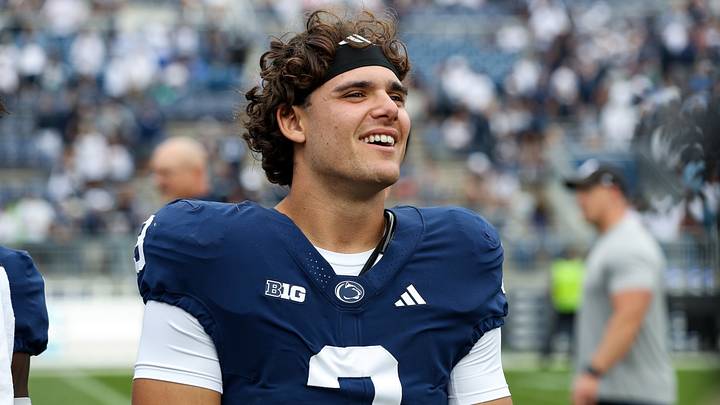
Penn State had a glorified preseason with three non-conference matchups against Marshall, Temple, and Buffalo. An overhauled program with a new coaching staff probably needed the long runway to Big Ten play in Week 4, but Rocco Becht, who entered the year as the most experienced quarterback in the country, certainly didn’t.
Becht didn’t finish one of Penn State’s three wins, ceding the way to redshirt freshman Alex Manske and, on two occasions, including a 55-13 Week 3 beatdown of the Bulls, Manske even allowed third-stringer Connor Barry to handle mop-up duty. Barry, however, attempted just one pass, so we’ll stick to grading Penn State’s QB of the present and its presumed QB of the future.
Rocco Becht’s red zone struggles are worth monitoring
As an undersized quarterback without traditional dual-threat ability, Becht is almost predisposed to struggle in the red zone. Becht is primarily a big-game hunter who thrives on picking his matchups and trusting his receivers downfield, and his best trait is his anticipation, which translates when he’s throwing to the intermediate level of the field.
The problem is that both of those strengths rely on stretching the field vertically. As the field condenses in the red zone, accuracy and arm strength are at a premium, and while Becht has solid ball placement and a serviceable arm, it’s not a reliable aspect of his game. That’s likely the reason that last season, Iowa State had a 78.1% run rate in the red zone.
So far this year, with Taylor Mouser still calling plays for Becht, Penn State is at a 55.6% run rate in the red zone. The run game has been struggling through the first three weeks, which means more responsibility falls on Becht, and heading into Week 3, Penn State ranked No. 124 in the FBS with a 70% scoring rate in the red zone and a 40% touchdown rate.
In Week 3, Penn State made four trips to the red zone with Becht in the game and scored on all four (3 touchdowns, 1 FG). However, much of that production was on the ground as Becht went 2/4 for 17 yards and a touchdown inside the Buffalo 20. Those aren’t bad numbers, but for the second straight week, he was at his worst closest to the goal line, including inexplicably running out of bounds behind the line of scrimmage rather than throwing the ball away.
Still, for those red zone issues, Becht got them there consistently because of his ability to push the ball downfield, going 6/8 for 176 yards on throws over 10 yards downfield and finishing the game with an 11.4-yard average depth of target.
Alex Manske did his job but narrowly missed a big day
One of the drives that Manske led gained just 10 yards and led to a punt, but that doesn’t necessarily reflect how the young quarterback played. The lone first down on the drive was a nicely thrown slant to Zay Robinson, low to protect his receiver from a hit over the middle and protect the ball.
Then, Manske narrowly missed Karon Brookins on a deep ball down the right sideline, taking a big hit to deliver it where only his receiver had a chance at it, before he calmly worked through his progressions on third down and narrowly missed converted quarterback Peyton Falzone high.
Manske’s biggest completion came on his third drive, hitting a wide-open Finn Furmanek down the right sideline for a 31-yard gain. The throw wasn’t particularly impressive, though it was on time and accurate, but it was nice to see Manske look comfortable turning his back to the defense off under-center play-action, which is a key element of the Mouser system.
In all, it was a decent showing from Manske in a run-heavy game script against a lesser opponent. He’s still on track to take over the program next year, though little that happened on Saturday could have changed that.
 Add us as a preferred source on Google