

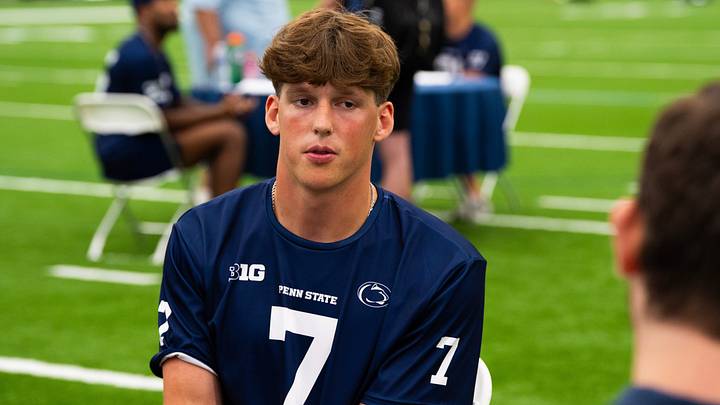
After serving as QB2 behind Rocco Becht at Iowa State as a true freshman, Alex Manske followed Matt Campbell to Happy Valley. Then, suddenly, he was gone - rehabbing back in Algona, Iowa, after what Campbell repeatedly called a “medical procedure.”
It turns out that the "medical procedure" was open-heart surgery to repair a dilated aortic root and a dilated ascending aorta, a common birth defect that carried no symptoms for the former four-star QB. It was found during Penn State’s routine heart screening for new athletes, “Which I didn’t have at Iowa State,” Manske told reporters on Tuesday after revealing the nature of his “medical procedure.”
According to Joe Resendez, Penn State’s director of football sports medicine, the abnormality was over the published threshold for medical disqualification. Hit the wrong way, and Manske could have died on the field.
Now, five months later, he’s back at Penn State fall camp, cementing his place as Becht’s backup and the heir apparent, and both he and his head coach have seen the benefits of making the jump to one of the country’s preeminent athletic departments.
A move to Penn State has already been the best thing for Alex Manske
Whether or not he ultimately fulfills that destiny as the heir apparent to Becht, the move to Penn State has already paid massive dividends for Manske because he avoided a potentially disastrous situation with his heart abnormality, which wasn’t caught at Iowa State.
Not only did the heart test and subsequent surgery, which was done at the Mayo Clinic in Minneapolis, preserve Manske’s career, but it may have saved his life. He’s now fully cleared and back on the field in Happy Valley. He detailed that path in a must-watch video put out by the Penn State social media team on Tuesday, just as Manske revealed to reporters the true nature of his offseason.
Some victories happen before the season even starts.
— Penn State Football (@PennStateFball) August 18, 2026
QB Alex Manske shares his story. pic.twitter.com/zg9UhGv3We
Typically, when you think about a coach making a move to a bigger, more well-resourced program in college football or any college sport, you think about recruiting advantages, a larger donor base, a better weight room, a bigger stadium, but you don’t often think about the finer details like the medical staff. But there is a difference when you level up to a Big Ten power such as Penn State from one of the most under-resourced Big 12 programs, Iowa State.
That’s not to blame Iowa State for missing this, necessarily. What matters is that this was caught before it became a problem and that Manske can continue his promising career. It is just to say that there are numerous advantages to being at a place like Penn State that Campbell seemingly overlooked during his 10 years at Iowa State, when he could have left for greener pastures.
Now, he’s finally at a powerhouse program, and good thing he made that leap when he did for his quarterbacks’ sake.
 Add us as a preferred source on Google